
Artificial Intelligence
& Mental Health
Innovation at the Service of Care

Why integrate artificial intelligence into mental health pathways?
In a world where mental health needs are constantly increasing, artificial intelligence (AI) proves to be a valuable tool to improve access, consistency, and personalization of support. It does not replace mental health professionals, but rather supports them by facilitating engagement, streamlining care journeys, and optimizing the user experience.
At C2Care, we have chosen to combine artificial intelligence and virtual reality to offer both individuals and professionals immersive, interactive, and intelligent support. Our AI is named Camille, and she embodies our vision of empathetic, responsive, and secure technology.
Try our artificial intelligence for free and discover how it can support you in your daily life.
Our AI solutions
Camille, your well-being ally
Camille, your well-being companion, available everywhere
Camille is much more than a synthetic voice. She is a conversational avatar available 24/7, capable of listening to you, guiding you, and adapting to your emotional needs and context. Designed to build a trusting and judgment-free relationship, Camille offers support that evolves and is currently available on:
Virtual Reality: for full immersion in therapeutic environments. You can speak with Camille inside 3D scenes where she guides and accompanies you.
Smartphone and computer: to continue your progress outside VR in a more accessible daily format, either as a complement or in full autonomy. This lets you interact with Camille anytime, explore your feelings, or prepare for an upcoming exposure.
The more you interact with Camille, the more she adapts to your needs and delivers personalized guidance.
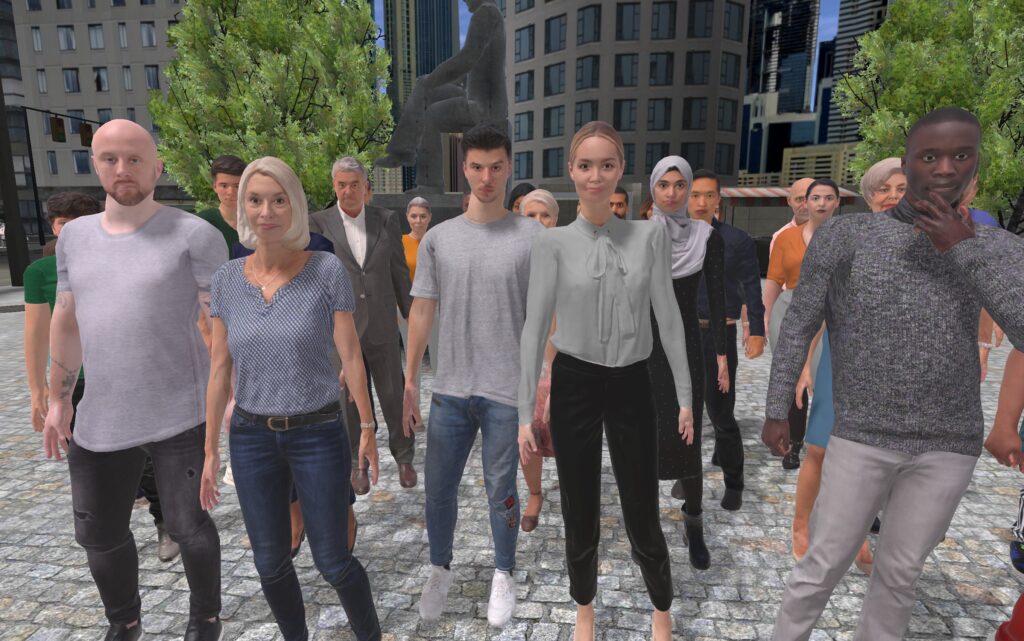
3D avatars
Camille for professionals, an intelligent assistant in development
Camille is not just for individual users. For mental health professionals (psychologists, healthcare facilities, therapists), she represents a new generation of intelligent digital assistants, currently being progressively rolled out within the C2Care ecosystem.
Designed to integrate into your day-to-day practice, Camille aims to support the planning, personalization, and monitoring of your therapy sessions. Here is a preview of the features currently under development:
Session planning and structure
Tracking interactions and progress
Smart recommendations
Centralized clinical follow-up
Camille is thus set to become your virtual clinical assistant, helping you save time, streamline your work, and focus on what matters most: the human connection.
Guided meditation

Other AI-powered features in the C2Care solution
Interactive 3D avatars
Characters within our immersive scenes are animated with AI, capable of reacting in real time to your voice, expressions, and behavior. This creates realistic social situations where users can speak, assert themselves, confront fears, or practice new behaviors.
Guided meditation and relaxation
AI helps make relaxation environments dynamic: Camille provides personalized suggestions, adaptive voice guidance, and real-time adjustments based on your reactions. Relaxation becomes fully interactive and responsive.
Real-time personalized feedback
During exposures or conversations, Camille can provide instant feedback tailored to your responses. This helps reinforce learning, build self-awareness, and sustain engagement.
With AI-generated dynamic hypnosis scripts, each session becomes a unique relaxation experience. This innovative approach allows for deep relaxation moments, accessible to everyone, anytime.
Lives changed thanks to our method.
Ethical and secure use of AI
At C2Care, we integrate AI within a strict ethical and legal framework. Your personal and health data is protected. Camille does not store any information without your explicit consent. All interactions are anonymized and hosted on secure servers in compliance with European regulations.
Our AI has been trained and calibrated with mental health professionals to ensure interactions are respectful, neutral, supportive, and never intrusive.
Data privacy
OpenAI complies with international data protection regulations, such as GDPR, ensuring the security and confidentiality of users’ personal information.
Transparency
OpenAI is committed to making its algorithms and operational processes as transparent as possible. This allows users to understand how their data is processed and how AI interacts with them.
Enhanced security
OpenAI continuously invests in improving system security to prevent unauthorized or malicious use of AI.
Ongoing monitoring
OpenAI conducts regular audits and implements monitoring mechanisms to detect and correct any potential issues, ensuring a reliable and secure experience.
Our Artificial Intelligence Charter
FAQ
Why use virtual reality in the field of mental health?
- Gradual and Controlled Exposure: VR allows patients to confront anxiety-inducing situations in a secure environment, gradually adjusting the intensity of stimuli to promote habituation and emotional regulation.
- Realistic and Reproducible Environments: Unlike traditional techniques, VR provides immersive scenarios that can be consistently reproduced, ensuring a coherent and effective approach.
- Increased Patient Engagement: The interactive and immersive nature of VR enhances treatment adherence and motivates patients to continue their therapy.
- Personalized Treatment: Virtual environments can be adapted to meet the specific needs of each patient.
- Versatile Applications: VR is used to treat anxiety disorders (phobias, post-traumatic stress disorder, obsessive-compulsive disorders), addictions, mood disorders, and even cognitive remediation.
How long has this existed?
How does virtual reality work?
What is a virtual environment?
What Equipment Is Needed to Use a Virtual Reality Headset?
Can virtual reality be dangerous?
What pathologies can be treated in virtual reality?
Can I feel nauseous while using the headset?
It can happen, it's called cybersickness. It's a phenomenon well known to scientists that affects a portion of the population.
Fortunately, it's reversible! To get used to it, it's recommended to start with fairly static environments (like relaxation environments), then make slight head movements. Then, you can gradually move on to slow movements.
This allows the body to adapt to the sensation of movement in the headset while remaining physically still.
Who can use virtual reality for treatment?
What Are the Benefits for Therapists Using VR ?
- Professional Differentiation: Integrating VR into practice allows therapists to stand out from traditional treatment options.
- Scientific Validation: VRET is backed by extensive research, reinforcing its credibility as an effective treatment method.
- Improved Patient Engagement: The interactive nature of VR fosters greater patient involvement in therapy.
- Time-Saving: VR provides direct access to various exposure environments without needing external logistics.
Do I have access to all environments ?
Who should I contact in case of software issues ?
Our technical support team can be reached via live chat from your control panel.
If you experience any issues with your headset, we will work with you to diagnose the problem and find a solution. If necessary, we will provide you with a return label and replace the defective equipment within 48 hours.
Which patients can benefit from TERV?
One of the considerable advantages of virtual reality is that it is effective on a wide spectrum of populations. Existing data from the literature on the subject shows us that it is entirely possible to expose a wide age group to virtual reality, with real therapeutic benefits.
The studies attest, in fact, to excellent feasibility and significant results; particularly in adults, in the treatment of anxiety disorders (including school phobia), autism, addictions, eating disorders, neuropsychological disorders, psychotic disorders and mood disorders.
The results are identical for adolescents with a significant added value concerning therapeutic engagement where virtual reality promotes adolescents' interest in their therapy.
Among elderly subjects, study results encourage the use of virtual reality with the aim of working on cognitive stimulation, on behavioral disorders but also on anxiety.
However, people with epilepsy and pregnant individuals are not advised to undergo this type of therapy.