
Fear of the dark: understanding and supporting those with this fear of darkness
Fear of the dark affects 5 to 15% of the population and reaches a developmental peak between the ages of 5 and 9 in children. Signs, neurological origins, validated strategies and warning signs: everything you need to know to support someone with this fear of darkness.
Key facts
- Fear of the dark affects 5 to 15% of the general population, with a peak in onset between the ages of 5 and 9.
- Up to the age of 7-8, this fear is considered developmentally normal: it reflects the awakening of the imagination.
- Validated strategies are available: emotional validation, bedtime rituals and gradual exposure to darkness.
- Warning signs to watch for include persistence beyond the age of 8, somatic symptoms and social withdrawal.
- When the fear becomes disabling, cognitive behavioural therapies (CBT) have a success rate of 70 to 80%; virtual reality exposure is a validated complementary approach for specific phobias.
How does fear of the dark manifest in children?
Fear of the dark rarely goes unnoticed. In children, it takes very concrete behavioural forms, often becoming intense at bedtime.
Most common signs:
- Refusal to go to bed or turn off the light
- Repeated requests for a parent to stay in the bedroom
- Crying, screaming or outbursts when the lights are turned off
- Restless sleep, frequent night-time awakenings, nightmares
- Imaginary fears projected into the darkness: monsters under the bed, witches behind the door, threatening figures
These signs generally appear between the ages of 2 and 8. Their intensity varies from child to child: some accept a night light and fall asleep quickly, while others cannot tolerate even partial darkness. Age plays a key role. Before the age of 5, the fear is often diffuse, linked as much to separation as to darkness itself. Between the ages of 5 and 8, it becomes more specific and rooted in more elaborate imaginary scenarios. An occasional fear that subsides after a few minutes of reassurance differs from a persistent fear that disrupts the whole family's sleep every night.
Why are we afraid of the dark?
Fear of the dark does not have a single origin. It brings together evolutionary mechanisms, specific neurological circuits and the power of the imagination, which is particularly active in children.
The evolutionary roots of fear of darkness
Darkness has long signalled danger. For our ancestors, night was the domain of nocturnal predators: heightened vigilance as darkness approached offered a direct survival advantage. This cautious reflex became biologically ingrained. Intrinsically photosensitive retinal ganglion cells detect declining light levels and activate the biological clock, signalling to the brain that a period of vulnerability is beginning. Fear of the dark is therefore not irrational in its origins: it is the remnant of a mechanism for adapting to a real danger. Problems arise when this warning signal becomes overactive in the absence of any concrete threat.
The neurological mechanisms of night-time fear
The brain treats darkness as a potential threat, even in the absence of an actual stimulus. Activity in the amygdala, the brain's threat detection centre, increases in the dark: this is the phenomenon of darkness-potentiated startle, which is well documented in neuroscience.
Researchers at the Sainsbury Wellcome Centre at University College London recently identified the brain circuits involved in fear suppression[1]. Their work, published in the journal Science, shows that two regions play a central role: the visual cortex, which processes visual information and contributes to learning to suppress fear, and the ventral lateral geniculate nucleus (vLGN), a subcortical structure that stores the memory of suppression and modulates communication between the thalamus and the amygdala. The endocannabinoid system is also involved: molecules released in the vLGN during learning promote a gradual reduction in fear responses. These findings open up direct therapeutic possibilities, particularly for specific phobias.
Darkness as a projection screen for the imagination
Darkness hides nothing, yet allows anything to be projected onto it. In children aged 2 to 8, the imagination is rich and the boundary between reality and fantasy remains porous. In the dark, an ordinary sound, the creaking of a door or the sound of the wind becomes evidence of a threatening presence. Stories heard in the evening, films and cartoons feed this store of images. Far from being a flaw, this projection reflects normal psychological development: the child is learning to inhabit a rich inner world. Fear of the dark is part of this process.
Is fear of the dark normal in children?
Yes, in the vast majority of cases. Fear of the dark is part of a child's ordinary development. The peak age of onset for specific phobias is between 5 and 9 years[2], and fear of darkness is one of their most common expressions. It reflects the awakening of the imagination and gradual psychological development.
Studies estimate the lifetime prevalence of specific phobias in the general population at between 5 and 15%. The sex ratio shows more than 2 women for every 1 man across all phobias. These figures remind us that fear of darkness is far from uncommon.
The threshold to watch is around 7-8 years of age. Before this age, spontaneous resolution is common as children gain cognitive maturity and confidence. Here is how this fear generally develops across age groups:
- 2-3 years: diffuse fear, often linked as much to separation anxiety as to darkness; spontaneous resolution is very common in a stable environment
- 4-5 years: more specific fear, populated by imaginary figures; the child begins to name their fears; a night light and a ritual are often enough
- 6-8 years: a possible peak in intensity, but the child has increasing cognitive resources to put the fear into perspective; signs of progress are expected with appropriate support
Beyond the age of 8, persistent, intense fear on a daily basis deserves attention. It is not automatically pathological, but it signals that more structured support, or even a consultation, may be helpful.
Strategies to help children overcome their fear of the dark
Validate, establish routines, adapt the environment, introduce gradual exposure: these four strategies, combined and adapted to the child's pace, are the best-documented approaches for supporting a child with a fear of the dark.
Validate the child's fear without dramatizing it
The first mistake is to minimize it: “It's nothing, there are no monsters.” The second is to dramatize it: “You're right, it's dangerous to be alone in the dark.” Both responses miss the mark.
Acknowledging fear without reinforcing it means telling the child: “I can see you're scared, that's normal, and you're safe.” This empathetic rephrasing validates the emotion while grounding it in reality. It distinguishes legitimate fear from actual danger. A child who feels understood without being overwhelmed by parental worry gradually develops their own ability to regulate this anxiety. Confidence develops not because the child has been told their fear is silly, but because they have been shown that it is manageable.
Establish a reassuring bedtime routine
Predictability is a powerful resource against anxiety. A consistent bedtime ritual lasting 20 to 30 minutes reduces the uncertainty that amplifies fear. The child knows what comes next, and this familiar sequence becomes reassuring in itself.
An effective routine might follow this sequence: a warm bath, pajamas, a calm story read in a soft voice, a cuddle, then gradually dimming the light. Parental consistency is crucial: a ritual followed inconsistently loses much of its calming effect. Avoiding screens in the hour before bedtime reduces the visual and cognitive stimulation that fuels the nighttime imagination. Bedtime should remain associated with safety, not negotiation or conflict.
Create a reassuring nighttime environment
The bedroom environment can be adjusted to reduce the intensity of fear without maintaining complete avoidance of darkness.
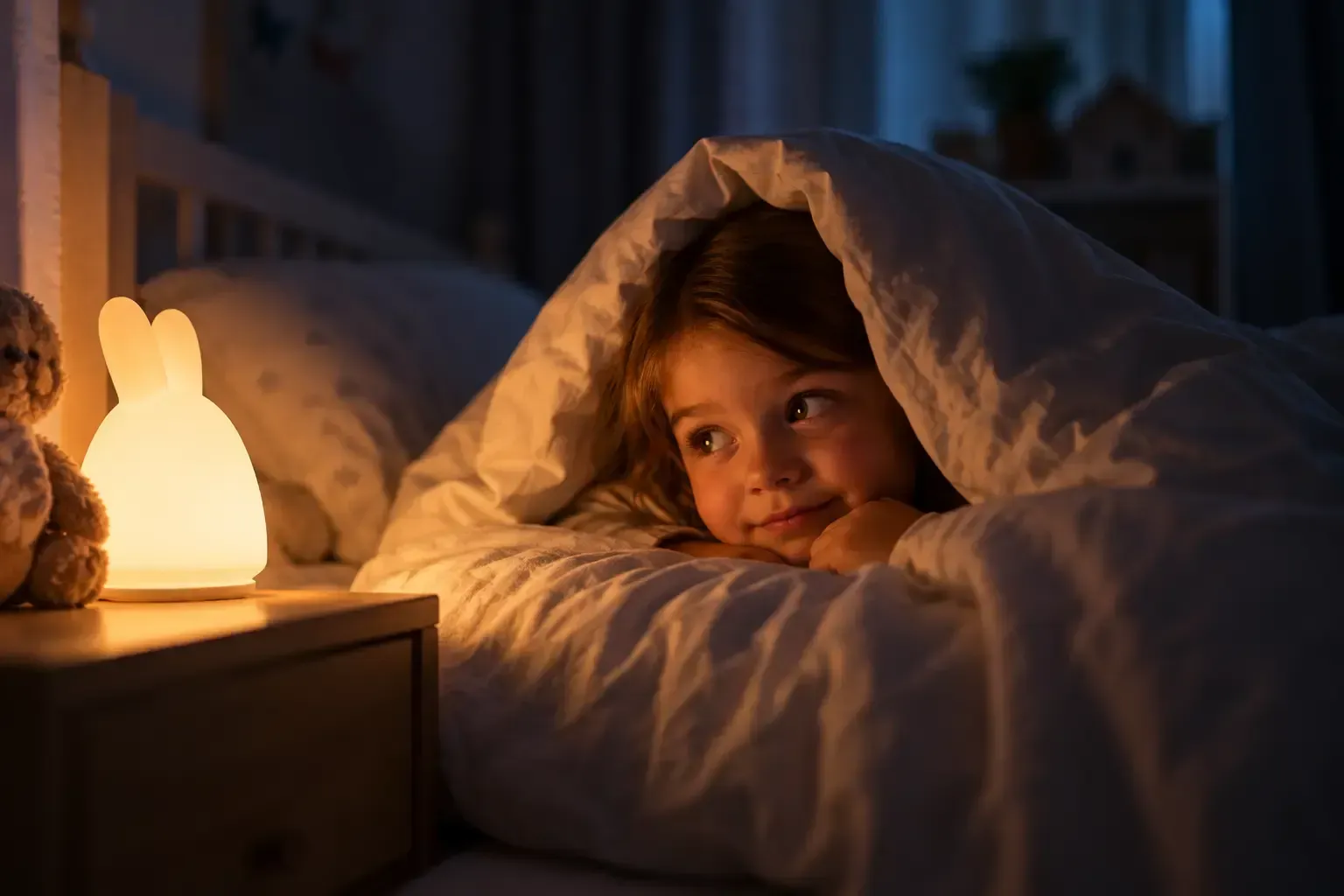
- Nightlight: choose a soft light with a color temperature between 2700 and 3000 K and adjustable brightness to allow a gradual transition to partial darkness
- Positioning: place the nightlight outside the direct line of sight from the bed, to provide light without glare
- Sounds: white noise or soothing music at low volume to mask nighttime sounds that fuel the imagination
- Comfort objects: a comfort blanket or familiar stuffed toy provides a reassuring symbolic presence
- Door ajar: maintain an auditory connection with the rest of the household without requiring a parent's physical presence
These adjustments are not intended to eliminate darkness, but to make it less threatening, step by step.
Gradually expose the child to darkness
Graded exposure is the central principle of behavioral therapies used for phobias. Applied to fear of the dark, it involves increasing contact with darkness very gradually, at a pace the child can tolerate.
Here is a 12-week schedule, to be practiced 3 to 4 times a week:
- Weeks 1-4: normally lit bedroom, full bedtime ritual, parental presence until the child falls asleep. Progress indicator: the child falls asleep without repeated crying.
- Weeks 5-8: transition to dim lighting (nightlight only), with the parent leaving the bedroom before the child falls asleep but remaining available. Progress indicator: the child accepts being alone for 5 to 10 minutes before asking for someone to be there.
- Weeks 9-12: partial darkness with the nightlight at its lowest setting, then lights off completely if the child agrees. Progress indicator: the child falls asleep alone in a dimly lit room.
Move on to the next phase only when the child feels comfortable. Forcing the pace has the opposite effect.
Use children's literature to help the child become more comfortable with fear
Books allow children to encounter their fear at a distance, through a character they identify with. The ideal time is before bedtime, but not just before lights out: the story should leave time for emotional processing.
Selection criteria: a reassuring or humorous tone, a hero the child can identify with, a positive resolution of the fear.
- Ages 2-4: picture books depicting the night poetically, stars, and friendly nocturnal animals; short format, soothing illustrations
- Ages 5-7: stories about funny monsters or brave heroes who overcome their fear of the dark; humor and identification with the main character
- Ages 8 and up: stories of nighttime adventures, coming-of-age tales in which darkness becomes a place of discovery rather than threat
Shared reading also creates a moment of emotional connection that strengthens the sense of safety at bedtime.

C2Care, a leader in immersive technologies for mental health
Create your free account to explore more than 250 virtual reality exposure scenarios and subscribe directly online.
When does fear of the dark become a problem?
The boundary between normal fear and an anxiety disorder is not always clear. A few criteria can help identify it.
Behavioral disturbances associated with a persistent fear of the dark[3] may include irritability, defiance of authority, social withdrawal or, in adolescents, marked avoidance of any nighttime situation. These signs deserve attention.
Comparison table: normal fear, persistent fear and anxiety disorder
| Criterion | Normal fear of the dark | Persistent fear of the dark | Anxiety disorder (achluophobia) |
|---|---|---|---|
| Age | 2-8 years | Over 8 years | Any age |
| Intensity | Moderate, subsides with reassurance | High, resists usual strategies | Very high, possible panic response |
| Impact on sleep | Occasional | Regular disruption | Chronic disruption |
| Functional impact | None or minimal | Family tensions, fatigue | Avoidance of situations, social/school impact |
| Somatic symptoms | Absent | Possible (stomachaches, headaches) | Frequent (palpitations, sweating, nausea) |
| Comorbidities | None | Associated mild anxiety | Generalized anxiety, depression, sleep disorders |
Simplified DSM-5 criteria for a specific phobia: marked and persistent fear of a specific stimulus (here, darkness), an anxiety response almost every time exposure occurs, active avoidance or endurance with intense distress, duration exceeding 6 months, significant impact on daily life.
If several of these criteria are met, consultation with a mental health professional is recommended. Phobia of the dark, known as achluophobia or nyctophobia, is a recognized and treatable specific phobia.
Fear of the dark in adults: understanding nyctophobia
Fear of the dark does not always disappear with childhood. In adults, it is often underreported because of social stigma: admitting to being afraid of the dark at 30 remains difficult. Minimum estimates suggest that at least 11% of adults are affected, with a strong likelihood that the true figure is underrepresented.
Its origins vary. Unresolved childhood trauma, a significant experience that occurred in darkness or a comorbid anxiety disorder can make this fear enduring. It does not result from a weakness of character, but from a neurological circuit that has not learned to distinguish actual danger from perceived threat.
Manifestations in adults differ from those in children. They include avoidance of nighttime situations (refusal to go out in the evening, inability to sleep without a light), hypervigilance to noises at night, chronic sleep disorders and anticipatory anxiety as night approaches. The impact on daily life can be significant: poorer sleep quality, tensions in the couple's relationship, occupational limitations in jobs involving nighttime hours.
The good news: adult nyctophobia responds well to the same therapeutic approaches as other specific phobias, particularly CBT and gradual exposure.
When and how should you consult a professional?
Four signs warrant seeking a consultation without delay: very intense and lasting fear (more than 6 months), chronic disruption of sleep or family life, anxiety associated with other situations, and marked avoidance behaviors that limit daily activities.
The professional to consult depends on the situation. Here are the available options:
| Type of professional | Main approach | Average duration | Reimbursement |
|---|---|---|---|
| Psychologist | CBT, gradual exposure | 12-20 sessions | Not reimbursed except through the coordinated MonPsy care pathway |
| Psychiatrist | CBT, assessment for medication if a comorbid condition is present | Variable | Reimbursed by Sécurité sociale |
| Certified psychotherapist | CBT, behavioral therapies | 12-20 sessions | Not reimbursed |
Cognitive behavioral therapies carry a grade A recommendation for specific phobias[4]. They aim to modify irrational beliefs associated with darkness and gradually reduce avoidance behaviors. The success rate documented in the scientific literature is between 70 and 80%.
Virtual reality exposure is a validated complementary approach for specific phobias. It makes it possible to recreate controlled nighttime environments and grade exposure at the patient's pace, without depending on external constraints. C2Care provides mental health professionals with immersive environments to support patients in the treatment of phobias, including fear of the dark. The solution is used by more than 700 trained practitioners in more than 350 institutions, with 10 years of expertise in therapeutic virtual reality. The practitioner retains control over the exposure process and can adjust the settings in real time according to the patient's reactions.
For specific phobias treated with virtual reality exposure, this approach makes it possible, in particular, to offer reproducible sessions that can be used by different professionals and across several departments.
Key points about fear of the dark
Fear of the dark is normal until the age of 7-8. It affects 5 to 15% of the general population and peaks between the ages of 5 and 9. Four strategies have proven effective: validating the emotion without dramatizing it, establishing a predictable bedtime routine, adapting the nighttime environment, and gradually exposing the child to darkness according to a 12-week schedule.
The warning signs are clear: persistence beyond the age of 8, somatic symptoms, social withdrawal, or marked avoidance behaviors. In adults, nyctophobia is often underreported but treatable. CBT remains the standard approach, with a success rate of 70 to 80%. Virtual reality exposure offers a complementary, controlled setting adapted to each patient's pace. Consulting a professional remains the best decision when fear disrupts daily life over a prolonged period.
Frequently asked questions about fear of the dark
What is fear of the dark called?
Fear of the dark has two scientific names: achluophobia and nyctophobia. It is a specific phobia classified among anxiety disorders. It differs from ordinary fear in its intensity, persistence, and paralyzing effect on daily life. Occasional fear that subsides with reassurance does not fall into this category.
Why am I afraid of the dark?
Fear of the dark has multiple origins. From an evolutionary perspective, darkness once signaled the presence of nocturnal predators. Neurologically, the amygdala becomes more active in the dark, perceiving the absence of light as a potential threat. In children, a vivid imagination amplifies this signal. In adults, unresolved childhood trauma or a comorbid anxiety disorder may sustain this fear.
What is fear of darkness?
Fear of darkness is a fear of the absence of light that may manifest as anxiety, avoidance behaviors, and sleep disturbances. It is considered normal in children until the age of 7-8, when it reflects the emergence of imagination. It becomes pathological when it is persistent, intense, and significantly disrupts daily life.
At what age does fear of the dark occur?
Fear of the dark generally appears between the ages of 2 and 8, peaking between the ages of 5 and 9. It is a normal part of child development and reflects the emergence of imagination. Spontaneous resolution is expected around the age of 7-8. If the fear persists beyond this age and disrupts sleep or family life, a consultation with a mental health professional is recommended.
How can a child who is afraid of the dark be helped?
Four approaches are validated: validating the fear without minimizing or dramatizing it, establishing a predictable bedtime routine lasting 20 to 30 minutes, arranging the bedroom with a soft nightlight and comforting objects, and gradually exposing the child to darkness over a 12-week schedule. Parental consistency and respect for the child's pace are decisive.
Can fear of the dark persist into adulthood?
Yes. At least 11% of adults are affected, with substantial underreporting linked to social stigma. Adult nyctophobia may result from unresolved childhood trauma or a comorbid anxiety disorder. It manifests as avoidance of nighttime situations, hypervigilance, and chronic sleep disturbances. It responds well to cognitive behavioral therapies.
When should you consult a professional about fear of the dark?
A consultation is recommended if the fear persists beyond the age of 8 in a child, lasts more than 6 months, chronically disrupts sleep or family life, is accompanied by somatic symptoms (stomach aches, palpitations), or leads to marked avoidance behaviors. A psychologist or psychiatrist can offer appropriate care, particularly CBT.
What treatments are available for pathological fear of the dark?
Cognitive behavioral therapies (CBT) are recommended as first-line treatment, with a success rate of 70 to 80% for specific phobias. They combine cognitive restructuring and gradual exposure. Therapeutic virtual reality exposure is a validated complementary approach, allowing exposure to darkness to be graded within a controlled setting adapted to the patient's pace.
References
- article
Scientists discover the brain mechanisms that help us overcome our fears
Techno-Science.net
2024View - article
Some figures on specific phobias
Anxiete.fr
View - article
Fear of the dark in children and adolescents
Psychologue.net
2019View - article
Treatment recommendations for specific phobias
Vidal.fr
View
Author
C2Care
Related articles

Exposure therapy: how it works, effectiveness and protocols for anxiety disorders
Avoiding what frightens you provides short-term relief but worsens anxiety over time. Exposure therapy reverses this logic: gradual confrontation, habituation, documented results ranging from 50 to 80% depending on the disorder.
What is a phobia?
Phobos is the incarnation of fear, he followed his father on the battlefields. The panicky fear that he triggered at the mere sight of him reflects what a person feels when confronted with the object of their fear. There are many phobias and some are more well known than others, including agoraphobia and claustrophobia. On the other hand, aviophobia is less so as it affects many of those who would also dream of discovering fine sandy beaches.

Erythrophobia: understanding the fear of blushing in public
An anxiety disorder distinct from ordinary shyness, erythrophobia is characterised by an intense fear of blushing in public. Causes, physiological mechanisms, symptoms and validated treatments: everything you need to know.
My child is afraid to go back to school
Parents and guardians currently considering the choices to make when it comes to reopening schools during the height of a deadly outbreak may have an additional challenge on their hands: children afraid to return to the classroom. Feelings of agitation are common and expected in times of change or transition. This is especially true for children and adolescents returning to school or children entering kindergarten for the first time.
Fear of insects: a widespread phobia
Extreme fear of insects is called entomophobia and is one of the most common forms of phobia. It causes panic and acute anxiety in victims, but there are effective ways to get rid of it, such as virtual reality, medications, etc. Psychologists offer virtual reality therapies to help their clients overcome this fear by engaging in risky situations in a safe, virtual setting. These specialists use control settings to adjust the environment created by the computer. Complex virtual environments involve replicating aspects of the real world, through 360-degree panorama, 3D graphics and sounds. Children and adults can develop entomophobia, especially when they have previously had hostile experiences with a particular insect. With approximately 6% of the population suffering from entomophobia, C2care provides clients with psychological and medical treatment for various fears, eating disorders, addiction-related stress, and implements virtual reality exposure therapy into their program. Keep reading to understand how virtual reality can help eradicate the fear of insects.
Fear of abandonment
The fear of abandonment is a major anxiety linked to the idea that we do not deserve the love of others and that we will quickly be rejected. This anxiety has a significant impact on your life. It causes anxiety and psychological suffering. You sometimes have reactions of isolation, irritability, jealousy, aggressiveness that you do not always understand towards the people you love. A fear of abandonment eats away at the little joys you can have in your daily life.