
Hypnosis mask: how it works, effectiveness and precautions before buying
The hypnosis mask promises easier sleep and less stress. How it works, studies on hypnosis, precautions, prices and alternatives: what you need to know before buying.
Key facts
- A hypnosis mask combines an audio self-hypnosis narrative with lights and vibrations, with the eyes closed; the best-known is the Hypnos mask.
- Hypnosis shows promising effects on sleep, based on studies whose evidence remains weak[1]; to our knowledge, no published study evaluates the mask itself.
- The mask can support a relaxation ritual, but it does not treat chronic insomnia, for which CBT remains the first-line treatment[2].
- Flashing lights require caution in people with epilepsy[3].
- For guided work, hypnosis with a practitioner is another option, including in virtual reality with environments such as those from C2Care, controlled during the session.
What is a hypnosis mask and how does it work?
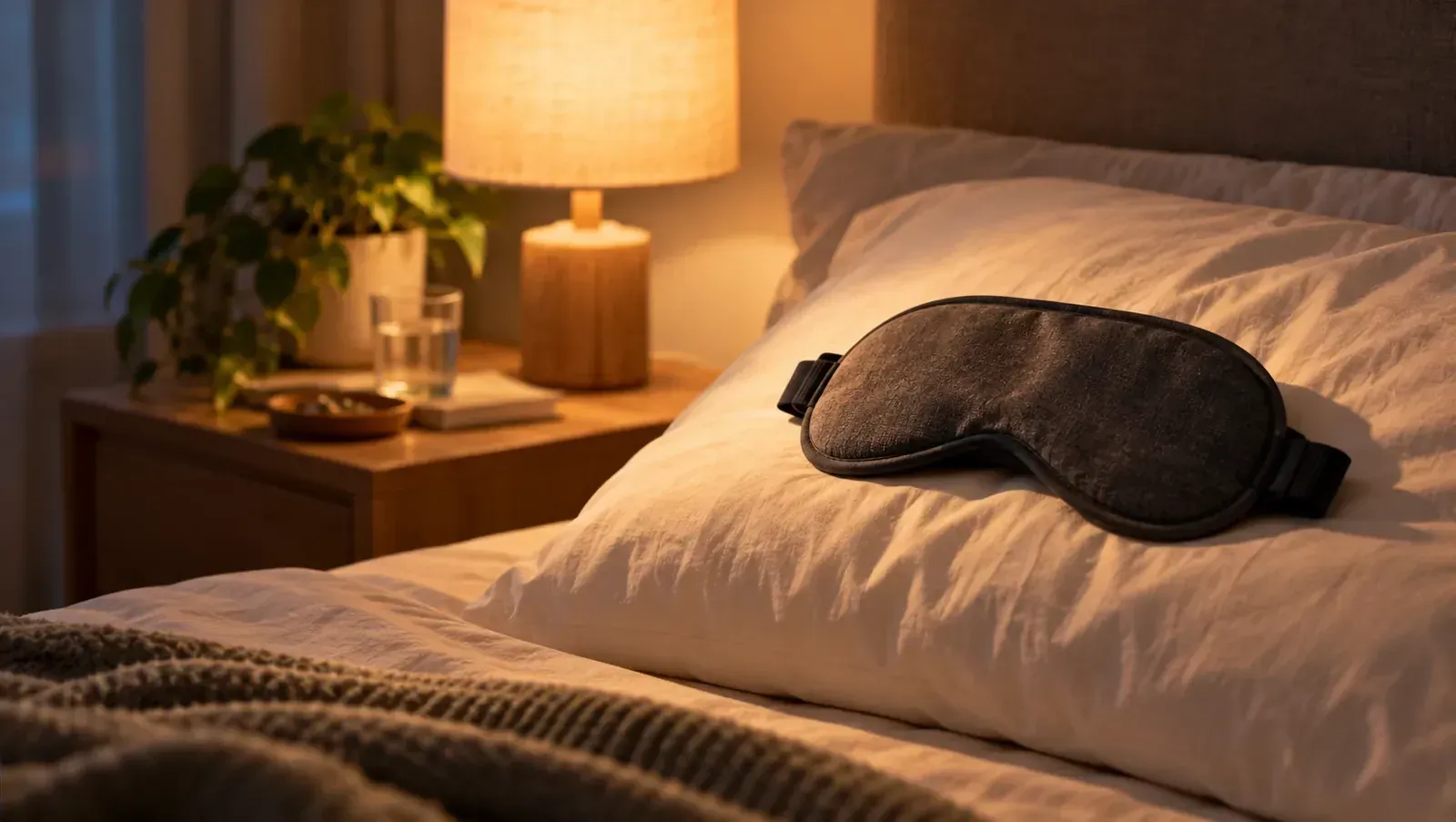
A mask, an app, a narrative. The hypnosis mask is a self-hypnosis tool: you place it over your eyes, start a session on your smartphone, and a voice guides you while the mask produces lights and vibrations synchronised with the narrative.
The reference model is the Hypnos mask, designed by the French brand Dreaminzzz. According to the manufacturer's website, accessed in October 2026, its apps offer more than 300 sessions covering 9 goals: sleep, relaxation, self-confidence, pain, emotions or addictions. Some versions are limited to audio, with earphones built into the fabric. Others add lights and vibrations for full immersion.
How do these stimuli work? Not by “programming” the brain. The lights and vibrations provide an anchor for attention and can set a rhythm for breathing, making it easier to achieve the focus characteristic of hypnosis. The narrative remains at the heart of the session: suggestions for relaxation, visualisation or breathing, which you follow with your eyes closed.
What types of hypnosis and sleep masks are available?
Under the same name, three types of products meet different expectations.
| Type | What it offers | Who it is for | Limitation |
|---|---|---|---|
| Connected self-hypnosis mask with lights and vibrations | Full immersion: synchronised audio narrative, lights and vibrations | People looking for a guided, immersive ritual | Higher price, caution with flashing lights |
| Audio mask with built-in earphones | Hypnosis or meditation sessions in a headband, without light | Bedtime use, people sensitive to light | No visual immersion |
| Simple light-blocking mask | Complete darkness | Anyone bothered by light | No guided support |
The Hypnos mask is available in the first two versions. A standard audio sleep mask, paired with a hypnosis app, recreates part of the experience, without the lights or vibrations. The choice therefore depends first on what you want: immersion, or simply a voice to guide you towards sleep.
What does science say about hypnosis and sleep?
Hypnosis has promising effects on sleep, but the evidence remains weak. This is the conclusion of the strongest research available.
The systematic review by Chamine et al. (2018) analysed 24 studies in adults: 58.3% of studies reported a benefit of hypnosis on sleep, 29.2% reported no benefit, and the others reported mixed results[1]. However, the authors highlight small samples and poor methodological quality. The meta-analysis by Lam et al. (2015) points in the same direction: hypnotherapy shortens the time it takes to fall asleep compared with no treatment, but does no better than a placebo intervention[4].
The Inserm report on hypnosis, published in 2015, notes that effectiveness has mainly been demonstrated for pain and anxiety during brief medical procedures, and for irritable bowel symptoms[5]. Sleep is not among these established indications.
One essential point remains if you are considering a purchase: these studies concern hypnosis, practised by a therapist or as self-hypnosis. To our knowledge, no published study specifically evaluates the effectiveness of the Hypnos mask. The available reviews consist of product tests and testimonials.
| Study | What was studied | Result | Limitation |
|---|---|---|---|
| Chamine et al., 2018[1] | 24 studies in adults | 58.3% reported a benefit on sleep, 29.2% reported none | Small samples, poor quality |
| Lam et al., 2015[4] | 13 trials, 502 participants | Faster sleep onset than on a waiting list, no difference compared with a placebo | 11 out of 13 trials were of poor quality |
| Inserm, 2015[5] | Evaluation of hypnosis | Effectiveness mainly for pain and anxiety during brief medical procedures, and irritable bowel symptoms | Sleep is not among the established indications |
Good to know: compared with a placebo intervention, hypnotherapy does no better for sleep onset[4]. Part of the effect is probably due to the ritual and expectations. This does not diminish the comfort experienced, but it is a reason to keep expectations measured.
Hypnosis masks and insomnia: what they can do, and what they do not replace
Insomnia is common. According to Inserm, it affects 15 to 20% of the population, including 9% with a severe form[2]. It becomes chronic when it occurs more than three times a week for at least three months.
At this stage, the first-line treatment is neither a mask nor a sleeping pill: it is cognitive behavioural therapy for insomnia[2]. Sleeping pills are only used for short periods or occasionally, and do not constitute treatment for chronic insomnia.
The hypnosis mask has a different role. It can support a bedtime ritual, help you switch off after a busy day or create a moment of relaxation. If your sleep difficulties persist, talk to your doctor: understanding sleep mechanisms and what interferes with falling asleep helps in choosing the right approach.
C2Care, a leader in immersive technologies for mental health
Create your free account to explore more than 250 virtual reality exposure scenarios and subscribe directly online.
What precautions should you take before using a hypnosis mask?
Two points deserve your attention before first use: flashing lights, and the setting in which self-hypnosis is practised.
Flashing lights and epilepsy
Certain light stimuli can trigger seizures. According to the review by Fisher et al. (2022), flashes, patterns or colour changes trigger seizures in up to 1 in 4,000 people, with the highest risk from flashes between 15 and 20 Hz[3]. The manufacturer of Hypnos itself warns people with epilepsy on its website, while specifying that the light intensity is low and the mask is used with the eyes closed. If you have epilepsy or a history of seizures, seek your doctor's advice before any use, or choose an audio version without light.
Self-hypnosis and medical care
Inserm considers hypnosis to have a good safety profile when practised by qualified healthcare professionals[5]. App-guided self-hypnosis does not replace ongoing care for an anxiety disorder, depression or a psychiatric disorder: in these cases, its use should be decided on medical advice. A few simple precautions:
- Position: lying down or seated, in a quiet place.
- Context: never while driving or during a task that requires alertness.
- Phone: in airplane mode during the session, as recommended by the manufacturer.
- How you feel: stop the session at the slightest sign of feeling unwell or uncomfortable.
How much does a hypnosis mask cost?
The budget depends on the version you choose and access to sessions. Here are the prices displayed on the manufacturer's website in October 2026, which are subject to change. The products were listed as out of stock at that time.
| Version | What is included | Displayed price |
|---|---|---|
| Hypnos 2, built-in earphones | 50 audio sessions | 79 € |
| Hypnos 2, built-in earphones | 150 audio sessions | 99 € |
| Hypnos 2, full immersion | Lights, vibrations and 300 sessions | 189 € |
| Hypnos 1 | Lifetime subscription to the apps | 79 € (promotional price) |
Depending on your usage, the session subscription may account for as much of the cost as the mask itself. Outside a bundled offer, the Hypnos app costs 4,99 € per month, 49,99 € per year or 149 € for lifetime access, and some programmes are free. As for the hardware, the manufacturer states up to 20 hours of battery life in audio mode, USB-C charging and a weight of 100 grams.
A hypnosis mask or a hypnosis session with a practitioner?
The mask is a self-hypnosis tool for the general public. A session with a practitioner is different in nature: personalised, adapted to your reactions and supervised by a trained professional.
In a consulting room, hypnotic induction often relies on verbal descriptions of calming images, such as mountains, the seaside or a forest. This visualisation depends on the patient's imagination, and sounds in the consulting room can make it harder to let go. Virtual reality can provide support here. With C2Care, the practitioner offers immersive, realistic and controlled environments featuring mountains, the sea and beaches, forests or gardens, enriched with auditory stimuli. They choose the scene to adapt the session to each patient's needs and adjust it in real time to retain control over how the session unfolds. Sessions of virtual reality hypnosis thus keep the practitioner at the centre: the environment supports induction; it does not replace hypnotic support.
The evidence still calls for caution. According to Thompson et al., virtual reality imagery may increase engagement in self-hypnosis, particularly among people who struggle to visualise an image, with no demonstrated gain in effectiveness at this stage[6].
| Criterion | Self-hypnosis mask | Hypnosis with a practitioner |
|---|---|---|
| Supervision | Alone, guided by an app | Trained professional |
| Personalisation | Prerecorded sessions | Adapted to each patient |
| Adjustment | None during the session | In real time, according to your reactions |
| Use | Relaxation and a daily ritual | Support for a disorder or a specific goal |
Key points about hypnosis masks
A hypnosis mask is a pleasant relaxation tool for those who enjoy this format. It draws on promising studies of hypnosis, rather than evidence specific to the mask. For occasional use, it may have a place in your evening routine. For an established disorder, support from a healthcare professional remains the preferred approach, and the two are not mutually exclusive. In a practitioner's setting, virtual reality as offered by C2Care extends this immersive approach, with added professional supervision.
C2Care, a leader in immersive technologies for mental health
Create your free account to explore more than 250 virtual reality exposure scenarios and subscribe directly online.
Hypnosis mask FAQ
How does a hypnosis mask work?
The mask connects to a smartphone app. You start a voice-guided self-hypnosis session with your eyes closed, while the mask delivers lights and vibrations synchronised with the narrative. Some versions are audio-only, with earphones built into the fabric.
Is the Hypnos mask effective?
To our knowledge, no published study specifically evaluates the Hypnos mask. Hypnosis shows promising effects on sleep, based on studies whose evidence remains weak[1]. User reviews are mixed: it is best approached as a relaxation tool, with measured expectations.
What is the best hypnosis mask?
There is no reliable ranking. The right choice depends on how you intend to use it: an audio mask to help you fall asleep, a version with lights and vibrations for full immersion, or a simple light-blocking mask. Your sensitivity to light and your budget also matter.
Can you use a hypnosis mask if you have epilepsy?
Caution is needed. Flashing lights can trigger seizures in some photosensitive people[3], and the manufacturer of Hypnos itself warns people with epilepsy. Ask your doctor for advice, or choose an audio version without lights.
How can you practise self-hypnosis without a mask?
Settle into a comfortable position and slow your breathing, as in cardiac coherence breathing, then focus on a calming image or sensation and repeat simple suggestions to yourself. Learning the technique with a professional trained in hypnosis helps you progress faster.
References
- scientific-study
Hypnosis Intervention Effects on Sleep Outcomes: A Systematic Review
Journal of Clinical Sleep Medicine
2018View - article
Insomnia
Inserm
2024View - scientific-study
Visually sensitive seizures: An updated review by the Epilepsy Foundation
Epilepsia
2022View - scientific-study
Hypnotherapy for insomnia: a systematic review and meta-analysis of randomized controlled trials
Complementary Therapies in Medicine
2015View - Report
Evaluation of the effectiveness of hypnosis practice
Inserm, rapport d'évaluation
2015View - scientific-study
A randomized controlled trial of the effects of hypnosis with 3-D virtual reality animation on tiredness, mood, and salivary cortisol
International Journal of Clinical and Experimental Hypnosis
2011View
Author
C2Care
Related articles
Virtual reality headset for relaxation: criteria for choosing well
On paper, virtual reality headsets for relaxation look alike. Types of solutions, studies, content, session control, equipment and budget: criteria for choosing well.

Sophrology
Reducing your anxiety by being completely in control of your body and your thoughts is the very principle of sophrology. This therapeutic technique is based on various methods of relaxation, breathing, and imagery which bring rapid and long-term relief. Sophrology has also proven itself when used accompanied by virtual reality.
Maslow's Hierarchy of Needs
What if your own development was not only dependent on you but on the fundamental needs present for every human being? What if understanding your needs made it easier to get closer to a feeling of well-being? Learn about Maslow’s hierarchy of needs.
Virtual reality therapy: therapeutic immersion to treat phobias, pain and anxiety disorders
Virtual reality therapy immerses the patient in a 3D environment under the control of a professional. Phobias, pain, addictions: indications, effectiveness and limitations.

Jacobson's progressive muscle relaxation: method, steps and benefits
Jacobson's relaxation, or progressive muscle relaxation, alternates contraction and release of the muscles. This guide details the method, its four phases, what research says about it and its precautions, for practitioners and their patients.
How virtual reality affects the brain: mechanisms, benefits and precautions
Virtual reality tricks the brain with measurable precision: altered brain waves, areas activated as in a real situation, accelerated learning. Discover the neurological mechanisms, validated benefits and essential precautions.