
How virtual reality affects the brain: mechanisms, benefits and precautions
Virtual reality tricks the brain with measurable precision: altered brain waves, areas activated as in a real situation, accelerated learning. Discover the neurological mechanisms, validated benefits and essential precautions.
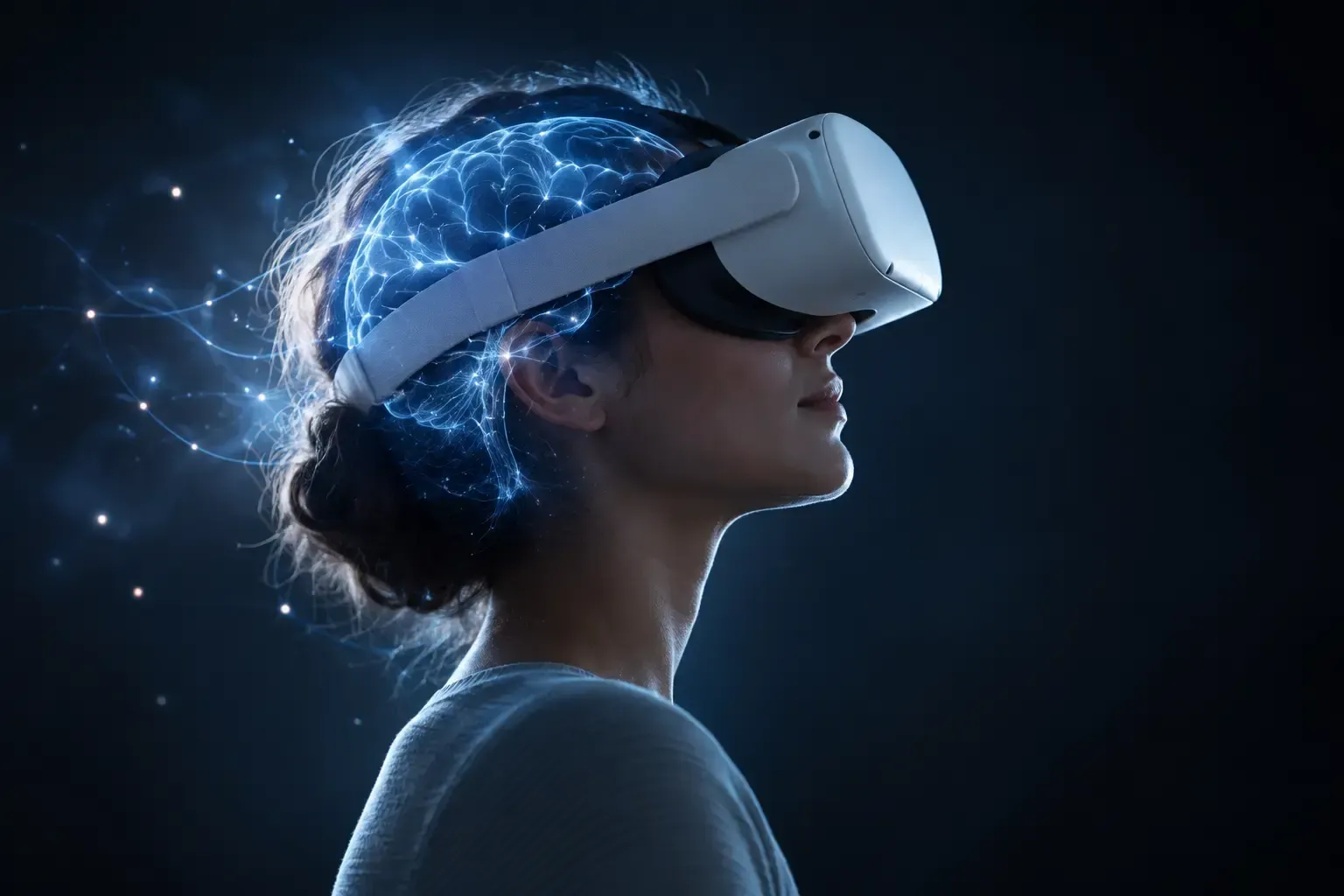
Key facts
- Immersion in virtual reality reduces alpha waves in the frontal, central and parietal regions of the brain, a sign of increased concentration measurable by electroencephalogram.
- According to a PricewaterhouseCoopers study (2024), learners using VR assimilate information up to four times faster than with traditional methods.
- Cybersickness (nausea, dizziness) affects 30 to 50% of users; the risk of a photosensitive epileptic seizure concerns 1 in 4,000 people.
- Therapeutic applications are validated for post-stroke motor rehabilitation (HAS recommendation, 2022) and the treatment of anxiety disorders and phobias through virtual reality exposure therapy.
- Anses recommends a rest period of 1 to 2 hours after each session and avoiding screens for 2 hours before bedtime, particularly for children.
The brain mechanisms behind immersion in virtual reality
Immersion in virtual reality triggers three distinct neurological processes: a measurable change in brain waves, the activation of specific brain regions and the emergence of a sense of spatial presence.
Changes in brain waves in a virtual environment
The brain is not passive when faced with a VR headset. In 2019, researchers at Tilburg University used electroencephalograms to measure the brain activity of participants immersed in virtual reality[1]. The result: a notable reduction in alpha waves in the frontal, central and parietal regions. These alpha waves are associated with a state of relaxation and low concentration. Their decrease therefore indicates increased concentration and high cognitive engagement. What the researchers observed was striking: brain activity in VR was similar to that recorded in situations experienced in the real world.
Brain regions activated during the VR experience
Three regions are of particular interest to neuroscientists. The frontal region is involved in the sense of presence, movement control and planning. The central and parietal regions handle engagement, spatial perception and the management of movements in space. During a VR climbing simulation, for example, the frontal region enters a state of intense concentration to plan each movement, while the parietal region becomes active to process spatial information. The stronger the immersion, the more the brain sets aside distractions to focus on the virtual environment.
The sense of presence and embodiment
Embodiment refers to bodily integration into a virtual environment: the feeling that your body belongs in this digital space. A study by Tjon et al. (2019) showed that this sense of spatial presence, meaning the illusion of being physically present in a virtual location, is directly correlated with a significant decrease in alpha waves in the frontal region. When immersion is sufficient, awareness of the real world fades. The brain stops distinguishing between simulation and lived reality.
The effects of VR on learning and cognitive performance
Three cognitive benefits are now documented: faster assimilation, stimulation of creativity and improved memory retention.
Assimilation up to four times faster
The figures are clear. A PricewaterhouseCoopers study (2024) found that learners using virtual reality assimilate information up to four times faster than those using traditional methods. The explanation lies in the very nature of immersion: VR makes it possible to recreate realistic situations in which learners can practise without risk, particularly for complex or stressful work-related tasks. Medical training, piloting, industrial technical procedures: brain engagement increases and information becomes more memorable. The brain processes a lived experience, not passive content.
Stimulating creativity and innovation
An experiment involving 21 participants compared creative exercises performed in VR and on a standard 2D screen. Participants immersed in VR showed higher levels of immersion, satisfaction and creativity. Their brain activity revealed increased activation of alpha, beta and gamma waves: beta waves reflect a state of active alertness, while gamma waves are involved in complex cognitive processing. Together, they promote a state conducive to generating innovative ideas.
Good to know: The brain does not always distinguish between VR and reality. Brain activity measured during virtual immersion is similar to that observed in situations experienced in real life: a Parisian café to learn French, a Madrid bar to practise Spanish. This neural confusion directly explains the educational effectiveness of virtual reality.
The health risks and side effects of virtual reality
Four categories of adverse effects have been documented: cybersickness, visual disturbances, sleep disturbances and the risk of epileptic seizures.
Cybersickness: nausea and dizziness in virtual environments
Cybersickness is virtual motion sickness. It affects 30 to 50% of users and manifests as nausea, dizziness, sweating, pallor and loss of balance. The mechanism is specific: the brain receives conflicting signals between what the eyes perceive (virtual movement) and what the body feels (actual stillness). This sensory mismatch causes the symptoms. In susceptible individuals, they can appear within the first few minutes of use. The Anses recommendations published in 2021[2] are clear: stop immediately at the onset of any symptom.
Visual disturbances associated with prolonged use
VR screens create an illusion of distance even though the screen is only a few centimetres from the eyes. This discrepancy between perceived and actual distance places unusual demands on the eye muscles. Prolonged use can cause eye strain and temporary visual disturbances. The LED screens in headsets also emit high levels of blue light. According to an Anses survey conducted in 2019, the average session lasts more than an hour, placing most users in a range of prolonged use that requires monitoring. No precise threshold has been defined to date.
Disruptions to the circadian cycle and sleep
Blue light emitted by the LED screens in VR headsets disrupts biological rhythms when exposure occurs in the evening or at night. Documented consequences include delayed sleep onset and impaired sleep quality. Anses recommends avoiding all screen exposure for two hours before bedtime, particularly for children and adolescents, who are more sensitive to blue light. This recommendation is all the more relevant given that sessions last more than an hour on average.
The risk of photosensitive epileptic seizures
The LED screens in VR headsets emit temporally modulated light, a flickering that is sometimes imperceptible to the naked eye. This phenomenon can trigger epileptic seizures in susceptible individuals. The prevalence is 1 in 4,000 people experiencing a seizure in response to flashing lights. Anses recommends avoiding VR use for people with epilepsy, as well as for other populations identified as sensitive: pregnant women, people who experience motion sickness, have balance disorders or are prone to migraines.
Good to know: Anses recommends a rest period of 1 to 2 hours after a VR session before any activity requiring a high level of concentration, such as driving. The body makes a considerable effort to adapt to the virtual world, resulting in real fatigue. Users often overlook this precaution.
Validated therapeutic applications of virtual reality
Three medical fields have demonstrated the effectiveness of virtual reality, and more specifically of virtual therapy: post-stroke motor rehabilitation, pain management and the treatment of anxiety disorders and phobias.
Motor rehabilitation after a stroke
The figures illustrate the scale of the challenge. In France, around 140,000 people have a stroke each year, 150,000 sustain a traumatic brain injury, 25,000 new cases of Parkinson's disease are diagnosed and 1,500 cases of cerebral palsy are recorded. Virtual reality supports the restoration of motor function by stimulating brain plasticity, the brain's ability to reorganise itself after an injury.
The Haute Autorité de Santé recommendations published in 2022[3] advocate VR as an adjunct to conventional therapy to improve motor function after a stroke, with a moderate level of evidence. The benefit is tangible: the exercises are engaging and motivating, whereas conventional rehabilitation can become repetitive and discouraging. Sessions help patients regain everyday movements (grasping an object, opening a door), improve balance and walking, or simulate real-life situations such as crossing a street or climbing stairs.
C2Care develops VR solutions for motor rehabilitation, deployed in 350 healthcare facilities in France, with support for medical teams.
Pain management for patients with severe burns and chronic pain
Results in patients with severe burns are among the most extensively documented. During care procedures, which are often very painful, immersion in virtual reality can significantly reduce perceived pain, by up to 60% according to some studies. The mechanism involves attention: virtual immersion engages a large proportion of the brain's cognitive resources. The patient pays less attention to pain signals. Measurements of brain activity confirm this reduction in areas associated with pain perception.
The approach also extends to chronic back pain, neck pain and postoperative pain. Its main advantage is that it is non-pharmacological, limiting side effects and the risk of dependence.
Treatment of anxiety disorders and phobias
Virtual reality exposure therapy (VRET) is based on a simple principle: gradually exposing the patient to a stressor in a safe, controlled environment. This habituation process allows the brain to modify its response to anxiety-provoking stimuli. Fear of flying (from going through security to turbulence), agoraphobia, specific phobias such as spiders, heights or syringes: each situation can be recreated and its intensity precisely adjusted.
VRET is more effective than conventional CBT for certain indications. Psychiatrist Éric Malbos treated patients with tobacco dependence using VRET: 72% had not relapsed after treatment, compared with 50% with CBT. Facilities such as Pitié-Salpêtrière in Paris, hôpital de la Conception in Marseille and CHU de La Réunion use this approach.
C2Care offers a comprehensive suite of therapeutic VR software for phobias and anxiety disorders, with more than 250 exposure situations available, controlled by the practitioner from a single platform. More than 700 practitioners have been trained in this approach.
C2Care, a leader in immersive technologies for mental health
Create your free account to explore more than 250 virtual reality exposure scenarios and subscribe directly online.
Brain–computer interfaces: when thought controls the machine
Controlling a device through thought alone, without any physical movement. This is the principle behind brain–computer interfaces (BCIs). These systems capture the brain's electrical signals via EEG and translate them into commands.
Adding virtual reality to BCI training environments significantly improves brain signal recognition and makes brain–machine interaction smoother. Recent research (Gougeh et al., 2023) shows that people with amputations can control prostheses more precisely through motor imagery in VR: the brain trains to generate the right signals in an immersive environment before transmitting them to the actual prosthesis.
Virtual reality neurofeedback takes this principle further. It is a closed-loop system in which the user's brain activity directly influences what they see and experience in the virtual environment. If the brain reaches a desired state of concentration, the environment becomes brighter or changes positively. Research on virtual reality neurofeedback[4] shows promising applications for anxiety management, ADHD and the optimisation of cognitive performance. Large-scale evidence is still being gathered, but initial results are encouraging.
Best practices for safe use of virtual reality
The recommendations from Anses and feedback from hospital practice point to the same precautions. Here are the rules to follow to limit adverse effects:
- Stop immediately when symptoms appear: nausea, dizziness, sweating, pallor. Do not wait for symptoms to worsen.
- Rest for 1 to 2 hours after each session before any activity requiring sustained concentration, particularly driving. The body makes a real effort to adapt to the virtual world.
- Avoid screens for 2 hours before bedtime, particularly for children and adolescents, who are more sensitive to the blue light from LED screens.
- Do not use VR if you have epilepsy or belong to a group identified as sensitive: pregnant women, people who experience motion sickness, have balance disorders or are prone to migraines.
- Inform users about potential effects through dedicated materials, whether in professional or general-public settings.
The 2019 Anses survey indicates that the average session lasts more than one hour. This finding reinforces the relevance of these precautions. The long-term effects of virtual reality on the brain, whether neurological or developmental, remain insufficiently documented and warrant further research.
Key takeaways on how virtual reality affects the brain
The effects of virtual reality on the brain are documented, measurable and multidimensional.
Brain mechanisms: VR reduces alpha waves in the frontal, central and parietal regions, activates areas involved in planning and spatial perception, and generates a sense of presence measurable by EEG. The brain responds as it would to a real situation.
Cognitive benefits: learning up to 4 times faster, stimulation of creativity, validated therapeutic applications for motor rehabilitation and the treatment of anxiety disorders.
Risks to be aware of: cybersickness in 30 to 50% of users, visual disturbances, sleep disturbances related to blue light, risk of epileptic seizures for 1 in 4,000 people.
Essential precautions: rest after sessions, avoid screens before bedtime, identify at-risk populations. Long-term effects remain to be documented.
FAQ on virtual reality and the brain
What effects does virtual reality have on the brain?
VR reduces alpha waves in the frontal, central and parietal regions of the brain, a sign of increased concentration. It activates the areas responsible for movement planning and spatial perception. The brain responds as it would in a real situation, creating a sense of presence measurable by electroencephalography. This neurological response explains the effectiveness of VR in therapeutic and educational applications.
What are the possible side effects of virtual reality?
Side effects include cybersickness (nausea, dizziness, sweating) in 30 to 50% of users, eye strain, sleep disturbances caused by blue light, and the risk of epileptic seizures in photosensitive individuals (1 in 4,000). These symptoms are generally reversible once exposure stops. Anses recommends stopping immediately when the first signs appear.
What impact does virtual reality have on health?
VR has validated therapeutic benefits for post-stroke motor rehabilitation, pain management and the treatment of phobias. It can also cause short-term adverse effects: cybersickness, visual disturbances and sleep disturbances. The long-term effects on the brain and development require further research before they can be fully characterised.
What is the potential of virtual reality for mental health?
Virtual reality exposure therapy (VRET) shows better outcomes than conventional cognitive behavioural therapies for anxiety disorders and addictions. For example, 72% of patients treated for tobacco dependence with VRET did not relapse, compared with 50% with traditional CBT. VRET is used in several French university hospitals for phobias, agoraphobia and post-traumatic stress.
How does VR improve learning?
According to a 2024 PricewaterhouseCoopers study, learners using VR absorb information up to four times faster than with traditional methods. Immersion engages the brain more, makes information more memorable and allows realistic situations to be recreated for risk-free practice, particularly for complex or stressful professional tasks in medical training, piloting or industrial technology.
What precautions should be taken when using VR?
Anses recommends stopping immediately if symptoms occur (nausea, dizziness), resting for 1 to 2 hours before any activity requiring concentration, avoiding screens for 2 hours before bedtime, and not using VR if you have epilepsy or are susceptible to motion sickness. These precautions also apply to pregnant women and people with balance disorders or migraines.
Can VR replace traditional medical treatments?
No, VR is a complementary tool, not a replacement. The Haute Autorité de Santé recommends VR as an adjunct to conventional therapy for motor rehabilitation after a stroke. In psychiatry, it is used alongside medication and therapeutic follow-up. It is always integrated into a comprehensive care protocol, under medical supervision.
How long can a VR headset be used safely?
No precise threshold has been defined, but the 2019 Anses survey indicates an average session duration of more than 1 hour. Adverse effects can appear within the first few minutes in sensitive individuals. It is recommended to rest after each session and stop immediately when symptoms appear, regardless of exposure duration.
References
- article
The impact of virtual reality on the brain: advances in training
Speedernet Sphere
2024View - article
Virtual reality, augmented reality: what are the risks? What good practices should be adopted?
Anses
2021View - article
How immersive extended reality technologies are transforming motor rehabilitation
Université Rennes 2
2025View - article
Why combine neurofeedback and virtual reality?
Neuromind
2026View
Author
C2Care
Related articles
Virtual reality in healthcare: therapeutic applications, measured benefits and real risks
Therapeutic virtual reality has moved from the laboratory to the treatment room. Pain management, phobia treatment, post-stroke rehabilitation: an overview of documented benefits and risks to be aware of.
Medical virtual reality: how technology is transforming healthcare
Medical virtual reality is a scientifically validated therapeutic tool already deployed in French CHU. Pain management, post-stroke rehabilitation, phobia treatment: discover its practical applications.
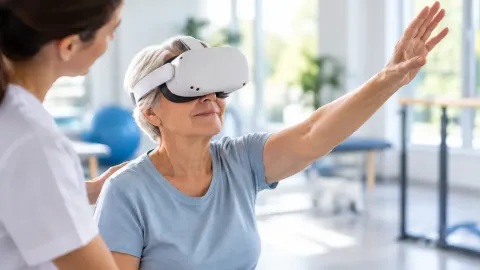
Virtual reality headsets in rehabilitation: applications, effectiveness and protocols in 2026
Virtual reality headsets are becoming established as a validated clinical tool in rehabilitation centres: motor recovery after stroke, neurodegenerative diseases, pain management. Protocols, effectiveness and equipment comparison in 2026.
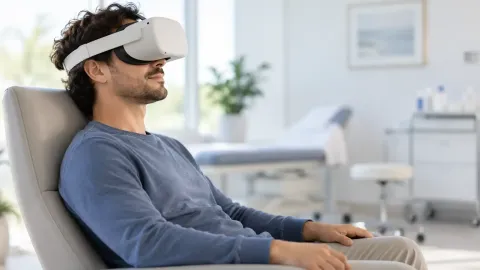
Virtual reality in healthcare: therapeutic applications and clinical outcomes in 2026
Virtual reality is transforming medicine: pain management, phobia treatment, post-stroke rehabilitation. Discover clinically validated applications and quantified outcomes in French and international hospitals.
Virtual reality in hospitals: therapeutic applications and outlook for 2026
Pain management, post-stroke rehabilitation, cybertherapies: virtual reality is establishing itself in French hospitals as a scientifically validated therapeutic tool, with measurable outcomes and growing adoption across healthcare facilities.
Virtual reality and social skills training with researchers from Aix-Marseille University.
A doctoral student in psychology in the Social Psychology Laboratory at the University of Aix-Marseille, I work with Dr Del-Monte, Ms Fauvarque, and Professor Graziani on virtual reality in the therapeutic context. In this context, I have had the pleasure of working for 3 years with C2Care software. The plurality and personalization of environments allowed me to have the freedom to direct my research in the desired direction without technological barriers.