
Virtual reality in healthcare: therapeutic applications and clinical outcomes in 2026
Virtual reality is transforming medicine: pain management, phobia treatment, post-stroke rehabilitation. Discover clinically validated applications and quantified outcomes in French and international hospitals.
Key facts
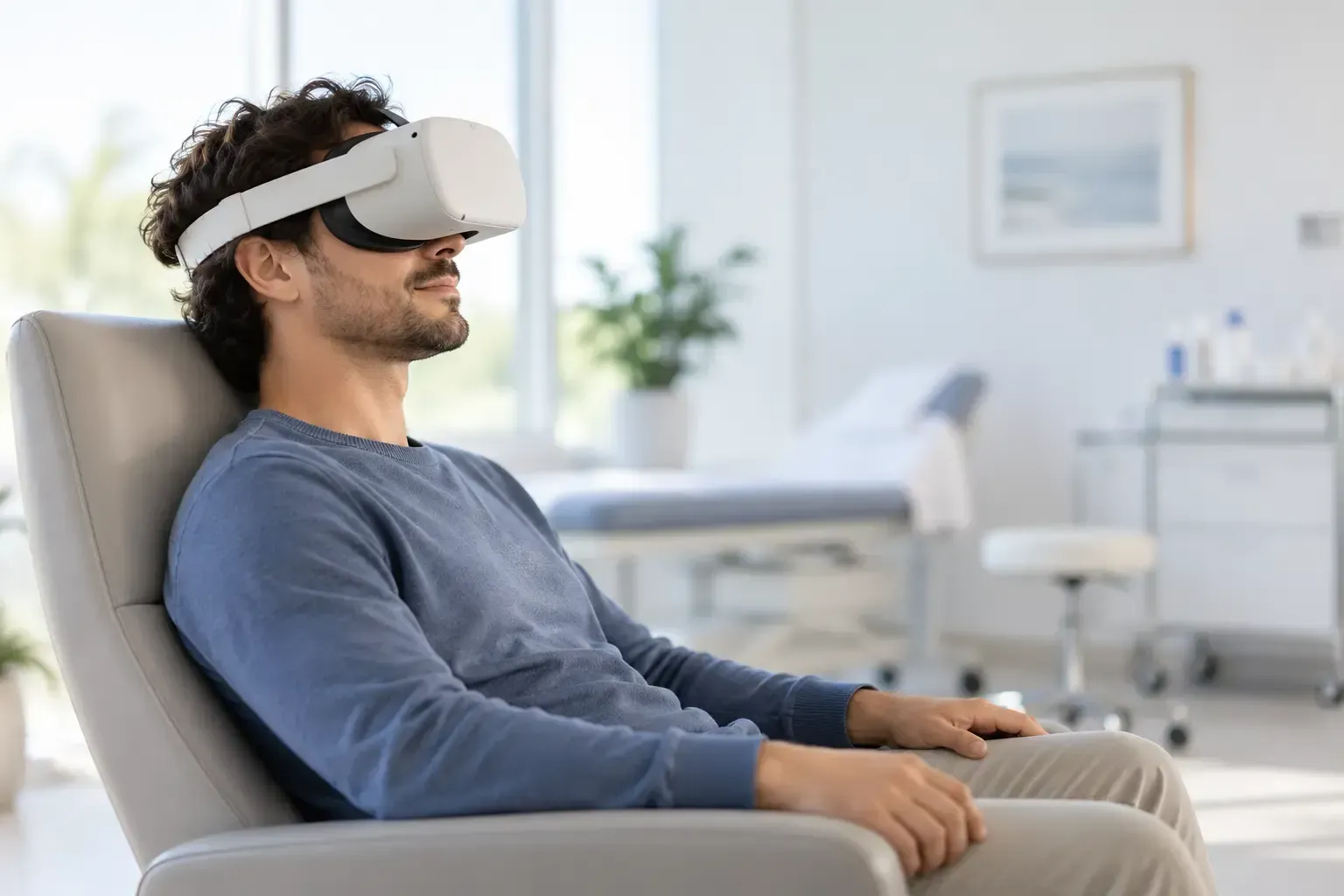
- Virtual reality is deployed in around thirty CHU in France, with validated applications in pain management, phobia treatment and motor rehabilitation.
- In patients with severe burns, immersion in a virtual environment reduces perceived pain by up to 60 %, as confirmed by measurements of brain activity.
- Since 2022, the Haute Autorité de Santé has recommended virtual reality as an adjunct to conventional therapy to improve motor function after a stroke.
- Virtual reality exposure therapy (VRET) draws on the principles of CBT to treat specific phobias, social anxiety and post-traumatic stress disorders.
- French solutions such as C2Care equip 350 healthcare facilities and support 700 trained practitioners in 25 countries, with more than 250 exposure situations managed from a single platform.
How virtual reality is transforming pain and anxiety management
Sensory distraction is the central mechanism: by engaging the brain's attentional resources, the virtual environment competes with pain and anxiety signals. This principle opens up practical possibilities in several clinical settings.
Reducing acute pain during care: outcomes in patients with severe burns
During care for patients with severe burns, which is among the most painful in medicine, immersion in a virtual environment produces measurable outcomes. Measurements of brain activity confirm a significant reduction in perceived pain[1] in areas associated with pain perception, with a reduction rate reaching 60 %. The mechanism is counterintuitive: the brain can only process a limited amount of information simultaneously. Immersed in a virtual world, it devotes fewer resources to pain signals. This is applied neurology, not magic.
Some solutions allow the practitioner to retain full control over gradual exposure during the session through real-time visual feedback, ensuring immediate adaptation to the patient's reactions.
Treating chronic pain and phantom limb pain
Phantom limb pain affects 60 to 80 % of amputees, according to a study by Université Aix-Marseille. This pain, felt in an absent limb, can become highly disabling in everyday life. Virtual reality in medicine offers a distinctive approach here: mirror therapy transferred to a virtual environment. By visualising a functional virtual limb, the patient gradually changes their body representation, reducing the intensity of phantom limb pain. The outcomes obtained demonstrate real efficacy for this chronic pain, which is particularly resistant to conventional treatments.
Managing anxiety before surgery and during medical examinations
Before surgery or an MRI scan, patient anxiety often complicates care. Immersion in a calming environment, a beach, a forest or a meadow, reduces this anxiety without medication. The benefit is twofold: no side effects, and an experience that the patient partially controls. For children undergoing dental care or medical imaging, this tool turns an anxiety-provoking moment into a tolerable experience. Care teams report better cooperation from young patients and fewer examinations postponed because of fear.
Good to know: Brain imaging confirms that virtual reality reduces activity in brain areas associated with pain perception. This is not a placebo effect: it is a measurable change in the neurological processing of pain signals.
Virtual reality exposure therapies for phobias and anxiety disorders
Cognitive behavioural therapies (CBT) provide the scientific framework for these approaches. The principle of gradual habituation, exposing the patient to what triggers their anxiety in a controlled environment, finds a particularly effective medium in virtual reality.
Treating specific phobias: flying, heights, enclosed spaces
Flying, entering a lift, being at a height: these situations are impossible to reproduce on demand in a conventional consulting room. Virtual reality makes them accessible at any time, without travel, without risk. For fear of flying, the patient virtually experiences every stage of the flight, from security screening to take-off, including turbulence. The therapist controls the intensity of each stage according to the reactions observed.
C2Care offers a platform bringing together more than 250 different exposure situations, covering specific phobias, social anxiety, public speaking and transport. From a single interface, the practitioner adjusts parameters in real time according to the patient's reactions, making each session truly individualised.
Agoraphobia and social anxiety
Simulating a dense crowd, a public square or a shopping centre: this is what virtual reality makes possible for patients with agoraphobia or social anxiety. These patients usually avoid such situations, which reinforces their disorder over time. The virtual environment allows a controlled increase in intensity, starting with a sparsely populated space before gradually increasing crowd density. The therapist remains present and can interrupt or adjust the exposure at any time. This approach faithfully reproduces the standard CBT protocol, with a flexibility that real life does not allow.
Post-traumatic stress disorders
For former military personnel or victims of attacks, mentally reliving a traumatic event without a safe framework can worsen symptoms. Virtual reality in medicine offers a structured protocol: the patient is gradually exposed to elements that evoke the trauma, with the therapist accompanying them throughout. Desensitisation develops session by session, in an environment fully controlled by the healthcare professional. Specific programmes have been developed for post-traumatic stress disorders in military personnel, with encouraging outcomes in reducing intrusive symptoms.
Motor rehabilitation and rehabilitation through virtual reality
In France, 140,000 people experience a stroke each year[2], alongside 150,000 traumatic brain injuries and 25,000 new cases of Parkinson's disease. Behind these figures are patients who must relearn how to move. Brain plasticity, the brain's capacity to reorganise after an injury, is better supported when rehabilitation starts early and proceeds in an appropriate, gradual manner.
Post-stroke rehabilitation: upper and lower limbs
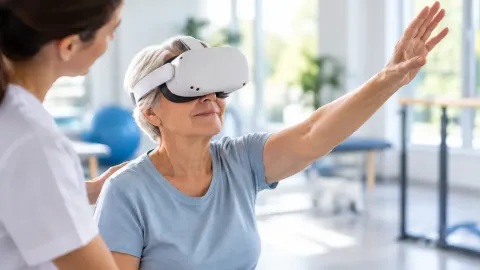
Grasping an object, opening a door, crossing a virtual street, climbing simulated stairs: these engaging motor exercises reproduce the everyday movements that patients must relearn after a stroke. Since 2022, the Haute Autorité de Santé has recommended virtual reality as an adjunct to conventional therapy to improve motor function after a stroke, with a moderate level of evidence.
The motivational advantage is decisive. Conventional rehabilitation exercises are often repetitive and perceived as discouraging. When transformed into playful interactions with clear goals, they sustain patient engagement over time. Progress is measurable and visible, which strengthens adherence to the protocol.
Parkinson's disease and neurological disorders
Virtual reality improves balance, walking and coordination in patients with Parkinson's disease. Immersive protocols also target certain cognitive functions that are often affected by the disease. An additional benefit deserves attention: a reduction in depressive symptoms, which are common in these patients. Exercising in a stimulating and rewarding environment changes the subjective experience of rehabilitation, beyond motor gains alone.
Cerebral palsy in children: postoperative rehabilitation
Keeping a child motivated throughout five months of postoperative rehabilitation is a daily challenge for care teams. Work conducted at the Université d'Évry has led to the development of an adaptable, game-based system: the child wears a headset and sees objects appear that they collect by moving around. The programme adapts to the level of disability, age and progress made, with objects becoming progressively harder to reach.
This approach illustrates a fundamental principle of virtual reality rehabilitation: eliciting purposeful actions, directed towards a concrete goal, rather than repetitive movements without context. The result is better transfer of benefits to everyday activities, something conventional methods struggle to achieve to the same degree.
Good to know: Skills acquired transfer better to real life with virtual reality because it elicits goal-directed actions, such as catching an object or avoiding an obstacle, rather than isolated movements without context. This principle, validated by neuroscience research, explains a significant part of its effectiveness.
Medical training, diagnosis and surgical preparation
Virtual reality in medicine is not limited to patients. Healthcare professionals also benefit from it in three distinct areas: initial training, preparation for complex procedures and visualisation of anatomical data.
Simulation of medical procedures for training
Medical students can now practise complex technical procedures without exposing a real patient to any risk. Simulation in a virtual environment allows a needle procedure, intubation or suturing to be repeated as many times as necessary, under varying, controlled conditions. The range of clinical cases available exceeds what a conventional hospital placement can offer. Technical skills develop more quickly, and mistakes made in simulation have no consequences for the patient.
Anatomical visualisation and surgical preparation
Before complex neurosurgery, the surgeon can explore a three-dimensional digital reconstruction of the patient's anatomical structures, generated from medical imaging data. This immersive visualisation transforms surgical planning: the spatial relationships between organs, blood vessels and tumours become tangible. The surgeon can anticipate difficulties, choose the optimal angle of approach and reduce the duration of the actual procedure. Tools such as Surgical Theater have made this approach operational in several neurosurgical centres.

C2Care, a leader in immersive technologies for mental health
Create your free account to explore more than 250 virtual reality exposure scenarios and subscribe directly online.
Scientific validation and official recommendations
Virtual reality in healthcare is no longer a matter of scientific curiosity. Evidence is accumulating, health authorities are taking positions, and protocols are becoming standardised in areas such as claustrophobia.
In 2022, the Haute Autorité de Santé issued an explicit recommendation: virtual reality is indicated as an adjunct to conventional therapy to improve motor function after a stroke. The level of evidence is rated as moderate, which corresponds to an advanced stage of validation for an emerging medical technology.
For pain, measurements of brain activity provide objective data. Reduced activity in pain perception areas during virtual immersion is not a subjective patient report: it is a signal measurable through functional imaging. In patients with severe burns, this mechanism produces a reduction in perceived pain of up to 60%[1].
For phobias and anxiety disorders, virtual reality exposure therapies fit within the established framework of CBT, whose effectiveness has been documented for several decades. VR adds a dimension of control and reproducibility that in vivo exposure cannot always guarantee.
Some French solutions participate in hospital–university research projects and develop their protocols based on the scientific literature. C2Care, with 10 years of expertise and deployment in 25 countries, illustrates this dynamic in which clinical practice and research advance together. This grounding in research is a condition of credibility for practitioners who incorporate these tools into their practice.
Deployment in French healthcare facilities
The adoption of therapeutic virtual reality in French hospitals has crossed a threshold. It is no longer limited to pioneering departments.
Equipped institutions include Pitié-Salpêtrière, Cochin hospital, Conception à Marseille hospital, and the CHU de Lyon, de Bordeaux et de la Réunion. Around thirty university hospitals are now equipped across the country. Departments using the technology span rehabilitation, psychiatry and operating theatres, demonstrating the tool's versatility.
C2Care supports 350 equipped institutions and 700 trained practitioners, with active deployment in 25 countries. This support includes training for healthcare teams and ongoing assistance, two key factors for successful adoption in hospital environments with limited resources.
For practitioners in private practice, flexible subscription models provide access to the technology without a substantial initial investment: 99 euros per month with no commitment or 799 euros per year. Compatible consumer headsets (Meta Quest, Pico) are sufficient to control sessions from a web browser, significantly lowering the barrier to entry.
Equipment costs remain a real barrier for some institutions. Medical devices certified for hospital use require a higher investment than consumer headsets, with software subscriptions, staff training and maintenance adding to the cost. Flexible business models are emerging to address this constraint.
Cybersickness, involving nausea and dizziness related to latency or graphics quality, affects some users. Its incidence is decreasing with newer generations of headsets that perform better on these parameters. The main contraindication remains photosensitive epilepsy. These adverse effects are generally mild and temporary, but must be anticipated in the care protocol.
Acceptance by healthcare professionals is a separate challenge. Some therapists initially express reservations about integrating technology into their practice. There is a learning curve, and specific training is necessary to make full use of the tool's capabilities. Practitioners who complete this step generally report a positive transformation in their therapeutic relationship with the patient.
Frequently asked questions about virtual reality in healthcare
How is virtual reality used in rehabilitation?
Virtual reality offers engaging, progressive motor exercises for the upper and lower limbs following a stroke, or in cases of cerebral palsy or Parkinson's disease. The environments simulate real-life situations: climbing stairs, grasping objects and crossing a street. The HAS has recommended this approach since 2022 to improve post-stroke motor function. Patient engagement is higher than with conventional repetitive exercises.
How effective is VR for treating pain?
In patients with severe burns, immersion in virtual reality reduces perceived pain by up to 60% during care. Sensory distraction engages the brain's attentional resources, as confirmed by measurements of brain activity in areas involved in pain perception. This non-pharmacological approach also applies to chronic pain and phantom limb pain in amputees.
Which French hospitals offer virtual reality therapy?
Pitié-Salpêtrière, Cochin, hôpital de la Conception à Marseille, and the CHU de Lyon, Bordeaux et de la Réunion are among the equipped institutions. Around thirty university hospitals in France offer this therapy in rehabilitation departments, psychiatry departments and operating theatres. Some French solutions equip 350 institutions in total, with deployment increasing since 2022.
Does therapeutic virtual reality carry any risks?
Cybersickness (nausea, dizziness) affects some patients, but its incidence is decreasing with newer generations of headsets. The main contraindication is photosensitive epilepsy. Sessions always take place under medical supervision. Adverse effects are generally mild and temporary, and supervised protocols limit the risks.
How much does virtual reality treatment cost?
The cost varies according to the institution and the condition being treated. For practitioners in private practice, subscriptions are available from 99 euros per month with no commitment, or 799 euros per year. Hospital costs are higher because of certified medical equipment. Some supplementary health insurers provide coverage in addition to that of Sécurité Sociale. A medical prescription is required.
What is the difference between virtual reality and augmented reality in healthcare?
Virtual reality immerses the user in an entirely digital environment through a headset, isolating them from the real world. Augmented reality overlays digital elements onto the visible real-world environment. VR is preferred for exposure therapy and distraction from pain. Augmented reality is used more for surgical guidance and contextual rehabilitation.
Can virtual reality treat phobias?
Yes. Virtual reality exposure therapy draws on CBT principles to treat specific phobias (flying, heights, enclosed spaces), social anxiety and agoraphobia. The therapist controls the intensity of exposure and adjusts the parameters according to the patient's reactions. This approach avoids travel to the feared location while faithfully reproducing exposure conditions.
Is virtual reality used in medical training?
Virtual reality simulation allows medical students to practise complex technical procedures without risk to the patient. It offers a variety of clinical cases that would be impossible to bring together in a conventional placement. For surgeons, 3D visualisation of anatomical data from medical imaging improves the planning of complex procedures, particularly in neurosurgery.
References
- article
Virtual reality therapy in hospitals: when technology provides care
Alan
2024View - article
How immersive extended reality technologies are transforming motor rehabilitation
Université Rennes 2
2025View
Author
C2Care
Related articles
Virtual reality in hospitals: therapeutic applications and outlook for 2026
Pain management, post-stroke rehabilitation, cybertherapies: virtual reality is establishing itself in French hospitals as a scientifically validated therapeutic tool, with measurable outcomes and growing adoption across healthcare facilities.
Virtual reality in healthcare: therapeutic applications, measured benefits and real risks
Therapeutic virtual reality has moved from the laboratory to the treatment room. Pain management, phobia treatment, post-stroke rehabilitation: an overview of documented benefits and risks to be aware of.
Medical virtual reality: how technology is transforming healthcare
Medical virtual reality is a scientifically validated therapeutic tool already deployed in French CHU. Pain management, post-stroke rehabilitation, phobia treatment: discover its practical applications.
Virtual reality headsets in rehabilitation: applications, effectiveness and protocols in 2026
Virtual reality headsets are becoming established as a validated clinical tool in rehabilitation centres: motor recovery after stroke, neurodegenerative diseases, pain management. Protocols, effectiveness and equipment comparison in 2026.
How virtual reality affects the brain: mechanisms, benefits and precautions
Virtual reality tricks the brain with measurable precision: altered brain waves, areas activated as in a real situation, accelerated learning. Discover the neurological mechanisms, validated benefits and essential precautions.

Formavenir, C2CARE and AP-HP revolutionize caregiver training with virtual reality and are finalists for the Sante Expo 2020 Innovation Trophies
The union of three experts gives rise to **Caregivers Ré.V**: serious game-type simulation training modules, using the immersive capacity of virtual reality to work on the soft skills of caregivers in the management of pain or the management of the aggressiveness of their patients. Supported by Formavenir, C2Care and the DMU Neurosciences du Kremlin-Bicêtre (AP-HP), this device is a finalist for the Santexpo 2020 Innovation Trophies, in the Human Resources category.