
Virtual reality in hospitals: therapeutic applications and outlook for 2026
Pain management, post-stroke rehabilitation, cybertherapies: virtual reality is establishing itself in French hospitals as a scientifically validated therapeutic tool, with measurable outcomes and growing adoption across healthcare facilities.
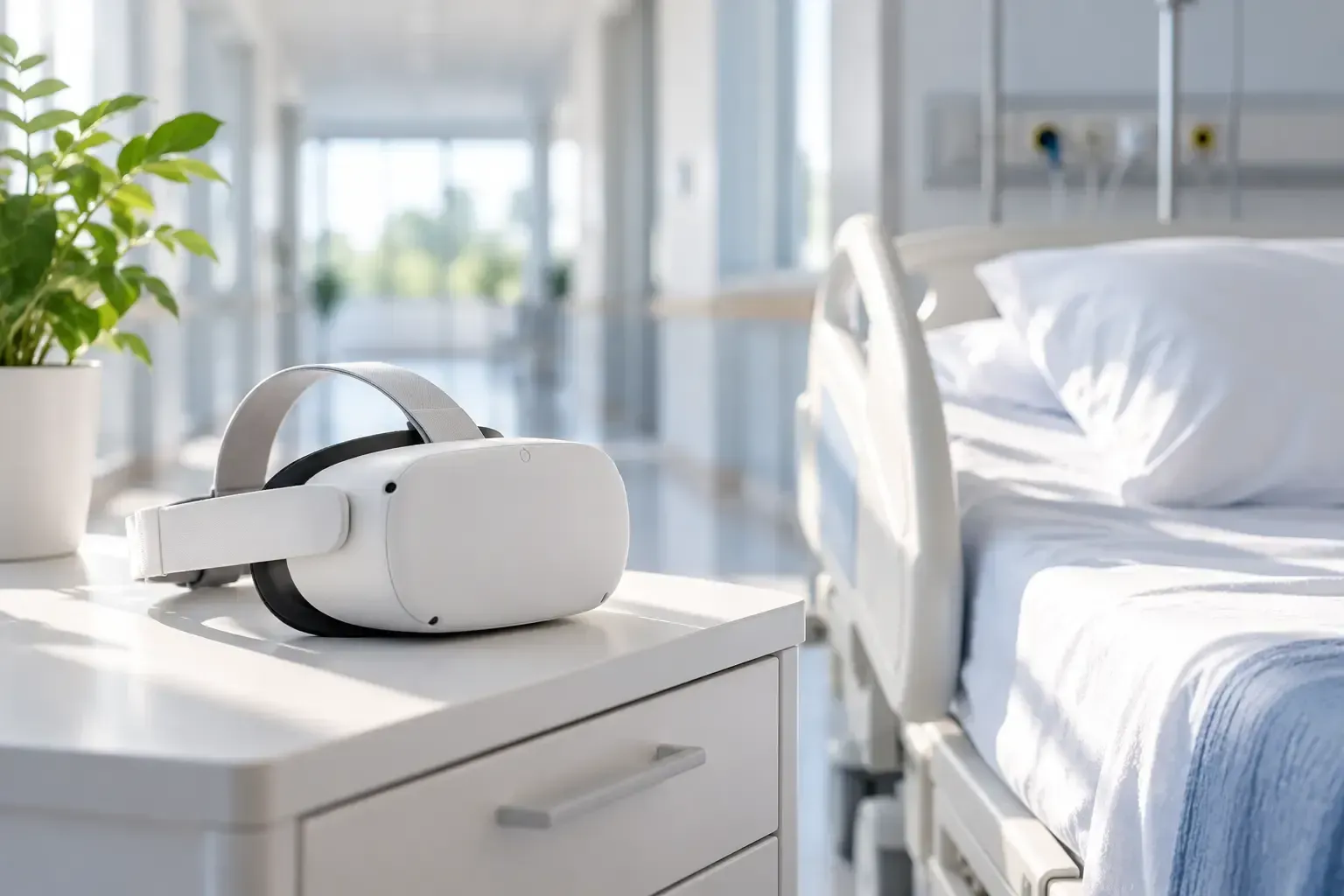
Key facts
- Clinical studies document a 35–50% reduction in perceived pain with virtual reality, reaching 60% in patients with severe burns.
- The Haute Autorité de Santé has recommended VR since 2022 to improve motor function after a stroke, with a moderate level of evidence.
- Measured benefits include improvements in balance, walking and coordination, as well as reductions in anxiety and depressive symptoms.
- The identified limitations remain manageable: temporary cybersickness in some patients, equipment costs and the need for staff training.
- Professional platforms such as C2Care allow practitioners to control exposure in real time through a dedicated interface, covering phobias, addictions and rehabilitation within a single tool.
How therapeutic virtual reality works in hospital settings
Therapeutic virtual reality immerses patients in a three-dimensional virtual environment using a stereoscopic headset. Two main forms coexist: immersive VR, in which the headset occupies the entire visual field, and non-immersive VR, displayed on a screen. In hospital settings, the immersive version predominates because it engages more of the brain's attentional resources.
The neurological mechanism rests on a validated principle: immersion diverts attention away from pain or anxiety signals, activates specific brain areas and supports a process of gradual habituation. This is not passive distraction. It is an active reconfiguration of perception.
The fundamental difference from consumer applications lies in the very design of the environments: validated medical protocols, mandatory professional support during every session, and ongoing adjustment by the practitioner. Certified professional solutions allow healthcare professionals to control exposure in real time through a dedicated control platform, changing the intensity of stimuli, the context or the duration according to the patient's reactions. This control over the course of exposure is a standard feature of certified medical devices, absent from consumer applications.
Managing pain and anxiety with virtual reality
This is the most scientifically documented application. When a patient wears a virtual reality headset during a painful procedure, their brain devotes a substantial share of its attentional resources to the immersive environment. Fewer resources remain available to process pain signals. A functional magnetic resonance imaging study confirmed a reduction of more than 50% in pain-related brain activity across five brain areas during VR exposure[1].
The quantitative data are robust. Research by Hunter Hoffman documents a 35–50% reduction in perceived pain among patients with severe burns during treatment, with peaks reaching 60% in some protocols[1]. These outcomes were obtained by combining VR with standard pharmacological treatments, opening up an important prospect: together, VR and opioids produce a significant additional reduction in pain, offering a concrete way to limit medication doses and the risks of dependence.
The settings in which it is used are varied. Care for patients with severe burns, chronic back pain, preoperative preparation, invasive procedures in children such as intravenous injections or dressing changes: in each of these cases, virtual immersion provides a measurable benefit. The advantage is twofold: a non-pharmacological intervention that limits side effects, and an experience that patients may accept more readily than a conventional analgesia session.
Motor rehabilitation and physical rehabilitation
Virtual reality is transforming rehabilitation protocols by offering purposeful, motivating exercises, where traditional approaches rely on decontextualized repetition of movements.
Recovery after stroke
Recommended by the Haute Autorité de Santé since 2022[2] to improve motor function after a stroke, VR offers exercises directly grounded in everyday situations. For the upper limbs: grasping an object, opening a door, pouring a drink. For the lower limbs: crossing a street, climbing stairs, avoiding obstacles. These environments simulate real-life situations and stimulate brain plasticity through repeated practice in an engaging context, supporting the transfer of gains to everyday activities, a benefit validated by rehabilitation studies.
Pediatric rehabilitation and neurological conditions
In children with cerebral palsy, postoperative gait rehabilitation benefits from systems that can be adapted to the level of disability, age and progress made. The program adapts continuously: objects to collect in the virtual environment gradually become harder to reach. For Parkinson's disease, studies show improvements in balance, walking, coordination and cognitive functions, along with a reduction in the depressive symptoms frequently associated with this condition. The main advantage remains sustained motivation over time, averaging five months, thanks to the interactive nature of the exercises.
Cybertherapies and treatment of psychological disorders
Virtual reality exposure therapies, referred to by the acronym TERV, are now a recognized treatment for anxiety disorders, specific phobias and addictions. The principle is that of cognitive behavioral therapies: gradually exposing patients to an anxiety-provoking situation in a safe setting until their emotional response recalibrates through habituation.
The conditions treated cover a broad spectrum. Fear of flying, agoraphobia, phobias of spiders, heights or enclosed spaces, tobacco dependence: each environment is designed to reproduce the patient's specific triggers. Outcomes for tobacco addiction are particularly well documented: psychiatrist Éric Malbos, a pioneer of cybertherapies at hôpital de la Conception in Marseille, reports a smoking abstinence rate of 72% after virtual reality treatment[3], compared with 50% with conventional CBT.
The effectiveness of TERV depends on the precision of exposure. Professional platforms allow environments to be adapted to each patient's specific triggers, the progressive intensity of stimuli to be adjusted, and control over the course of the session to be maintained through a dedicated interface. C2Care, for example, offers more than 250 exposure situations covering phobias, social anxiety and addictions, controlled by the practitioner from a single platform. TERV does not replace other treatments: it forms part of an overall protocol that includes motivational interviewing and, if necessary, medication.

C2Care, a leader in immersive technologies for mental health
Create your free account to explore more than 250 virtual reality exposure scenarios and subscribe directly online.
Validated benefits of virtual reality in hospital settings
First key benefit: a controlled and reproducible environment. Unlike exposure in real-life situations, VR does not depend on the weather, travel or the availability of a specific location. A practitioner can recreate an airport, a crowd or a staircase from their office, using the same settings from one session to the next.
Second advantage: personalisation. Settings, context, stimuli, intensity and pace are adjusted in real time according to the patient's goals and reactions. This adaptability is impossible to achieve with conventional approaches. Professional platforms bring together several therapeutic areas, including phobias, addictions, relaxation and cognitive stimulation, in a single tool, allowing practitioners to address varied needs without multiplying equipment.
Third benefit: the transfer of acquired skills. Studies on motor rehabilitation confirm that progress made in virtual environments is maintained in everyday activities, which is not always the case with exercises performed out of context.
Finally, safety. VR offers an alternative or a complement to pharmacological treatments, with fewer side effects. In France, thanks to C2Care, approximately 350 facilities are equipped and 700 practitioners trained, demonstrating real adoption, beyond experimental use.
Limitations and challenges of hospital implementation
Virtual reality in hospitals, used in particular for claustrophobia, is not without constraints. These fall into three categories.
Physiologically, some patients develop cybersickness: nausea, dizziness, eye strain or migraines during or after the session. These effects are generally temporary and subside once exposure ends. No serious adverse effects have been reported in clinical studies. Increased anxiety may occur during an exposure session, highlighting the importance of professional support. Contraindications include treated epilepsy, vestibular disorders and certain psychiatric conditions such as schizophrenia.
Economically, purchasing compatible VR headsets, software licences, maintenance and staff training represent a substantial initial investment. This investment must be weighed against measurable benefits: reduced use of pharmacological treatments, improved adherence to protocols and more efficient use of rehabilitation time.
Organisationally, integrating VR into routine care requires practitioners to adapt and receive structured training. The risk of dissociation, meaning a different response in a virtual environment compared with a real-life situation, requires virtual reality exposure therapy to be combined with other therapeutic approaches rather than used alone. VR is one tool among others, not a standalone protocol.
Frequently asked questions about virtual reality in hospitals
How is virtual reality used in rehabilitation?
VR offers motor exercises in immersive environments that recreate everyday situations: crossing a street, grasping objects or climbing stairs. The patient interacts using a headset and motion sensors, while the therapist adjusts the difficulty and monitors progress in real time. Recommended by the HAS for post-stroke rehabilitation, it improves balance, coordination and walking, with motivation sustained over time through goal-directed exercises.
What virtual reality software is used in hospitals?
Facilities use certified medical software designed in accordance with validated clinical protocols. These applications cover pain management, motor rehabilitation, cybertherapies for phobias and addictions, and surgical training. The main differences from consumer games are mandatory professional support, real-time adjustments by the practitioner, objective measurement of progress and regulatory compliance as a medical device.
How much does a therapeutic virtual reality solution cost?
Costs vary according to the type of solution and the scope of deployment. For practitioners in private practice, monthly subscriptions at 99 € or annual subscriptions at 799 € provide access to a comprehensive library of therapeutic environments. For facilities, tailored packages include hardware, multi-user licences, staff training and maintenance. The initial investment should be weighed against reduced use of pharmacological treatments and more efficient use of rehabilitation time.
What are the 3 pillars of therapeutic virtual reality?
Sensory immersion (visual through a stereoscopic headset, auditory through spatialised sound), interaction (the patient acts within the virtual environment using controllers or motion sensors) and presence (the feeling of actually being in the virtual world). Together, these three pillars enable therapeutic effectiveness: capturing attention to reduce pain perception, engagement to facilitate prolonged rehabilitation, and controlled gradual exposure for cybertherapies.
Which hospitals in France use virtual reality?
Around thirty CHU are equipped in France. Pioneering facilities include la Pitié-Salpêtrière, Cochin, Antoine Béclère and Bicêtre in Île-de-France, l'hôpital de la Conception in Marseille, and les CHU de Bordeaux, Lille, Lyon et La Réunion. Private clinics such as l'Hôpital Privé du Confluent in Nantes and la Clinique Claude Bernard in Metz have also deployed VR solutions, mainly for pain management and rehabilitation.
Is virtual reality reimbursed by l'Assurance maladie?
Coverage by l'Assurance maladie remains limited and depends on the care context. Some supplementary health insurers may provide additional coverage when VR is prescribed within a structured medical framework. The HAS has recommended VR for post-stroke rehabilitation since 2022, marking a step towards broader official recognition. Consult your doctor or supplementary health insurer to find out which coverage conditions apply to your situation.
What are the contraindications to virtual reality in medical settings?
Several conditions contraindicate VR use: treated epilepsy, vestibular disorders, certain psychiatric conditions such as schizophrenia, major neurocognitive disorders and severe visual impairment. Cybersickness (nausea, dizziness) may occur in patients without a formal contraindication but remains temporary. A prior assessment by a healthcare professional is essential before any session to evaluate whether VR is appropriate for the patient's profile.
Does virtual reality replace conventional medical treatments?
No. Virtual reality complements existing treatments; it is not a substitute. It is integrated into protocols combining therapeutic support, medication if necessary, and other rehabilitation or psychotherapy approaches. Its effectiveness is specifically documented in combination with pharmacological treatments, particularly for pain. All use must take place under the supervision of a qualified healthcare professional.
References
- article
Virtual reality therapy in hospitals: when technology provides care
Alan
2024View - scientific-study
Virtual reality for managing pain and anxiety in children
PMC / Canadian Family Physician
2017View - article
Virtual reality as a treatment in psychiatry
EtuMed, Université de Genève
2023View - article
What are the benefits of virtual reality compared with other therapeutic approaches after a stroke?
Cochrane
2023View
Author
C2Care
Related articles
Virtual reality in healthcare: therapeutic applications and clinical outcomes in 2026
Virtual reality is transforming medicine: pain management, phobia treatment, post-stroke rehabilitation. Discover clinically validated applications and quantified outcomes in French and international hospitals.
Virtual reality in healthcare: therapeutic applications, measured benefits and real risks
Therapeutic virtual reality has moved from the laboratory to the treatment room. Pain management, phobia treatment, post-stroke rehabilitation: an overview of documented benefits and risks to be aware of.
Medical virtual reality: how technology is transforming healthcare
Medical virtual reality is a scientifically validated therapeutic tool already deployed in French CHU. Pain management, post-stroke rehabilitation, phobia treatment: discover its practical applications.
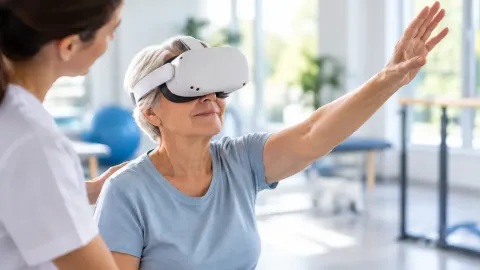
Virtual reality headsets in rehabilitation: applications, effectiveness and protocols in 2026
Virtual reality headsets are becoming established as a validated clinical tool in rehabilitation centres: motor recovery after stroke, neurodegenerative diseases, pain management. Protocols, effectiveness and equipment comparison in 2026.
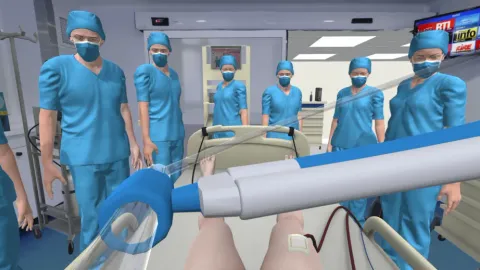
A world first: virtual reality for lung transplantation
For the first time in the world, a patient on the lung transplant list will be able to benefit from therapeutic virtual reality sessions to prevent post-operative psychological trauma, thanks to the unprecedented partnership between C2Care and AP-HM (Public Assistance – Marseille Hospitals).

Formavenir, C2CARE and AP-HP revolutionize caregiver training with virtual reality and are finalists for the Sante Expo 2020 Innovation Trophies
The union of three experts gives rise to **Caregivers Ré.V**: serious game-type simulation training modules, using the immersive capacity of virtual reality to work on the soft skills of caregivers in the management of pain or the management of the aggressiveness of their patients. Supported by Formavenir, C2Care and the DMU Neurosciences du Kremlin-Bicêtre (AP-HP), this device is a finalist for the Santexpo 2020 Innovation Trophies, in the Human Resources category.