
Medical virtual reality: how technology is transforming healthcare
Medical virtual reality is a scientifically validated therapeutic tool already deployed in French CHU. Pain management, post-stroke rehabilitation, phobia treatment: discover its practical applications.
Key facts
- VR reduces pain by up to 60% in patients with severe burns without additional medication
- Recommended by the HAS since 2022 for post-stroke motor rehabilitation (level of evidence B)
- Treats phobias and anxiety disorders through controlled, gradual exposure in an immersive environment
- Solutions such as C2Care offer more than 250 exposure situations, covering phobias, social anxiety, addictions and relaxation
- Already used in French CHU: Pitié-Salpêtrière, Marseille, Lyon, Bordeaux
- An adjunct to traditional therapies, always with support from a healthcare professional
What is therapeutic virtual reality?
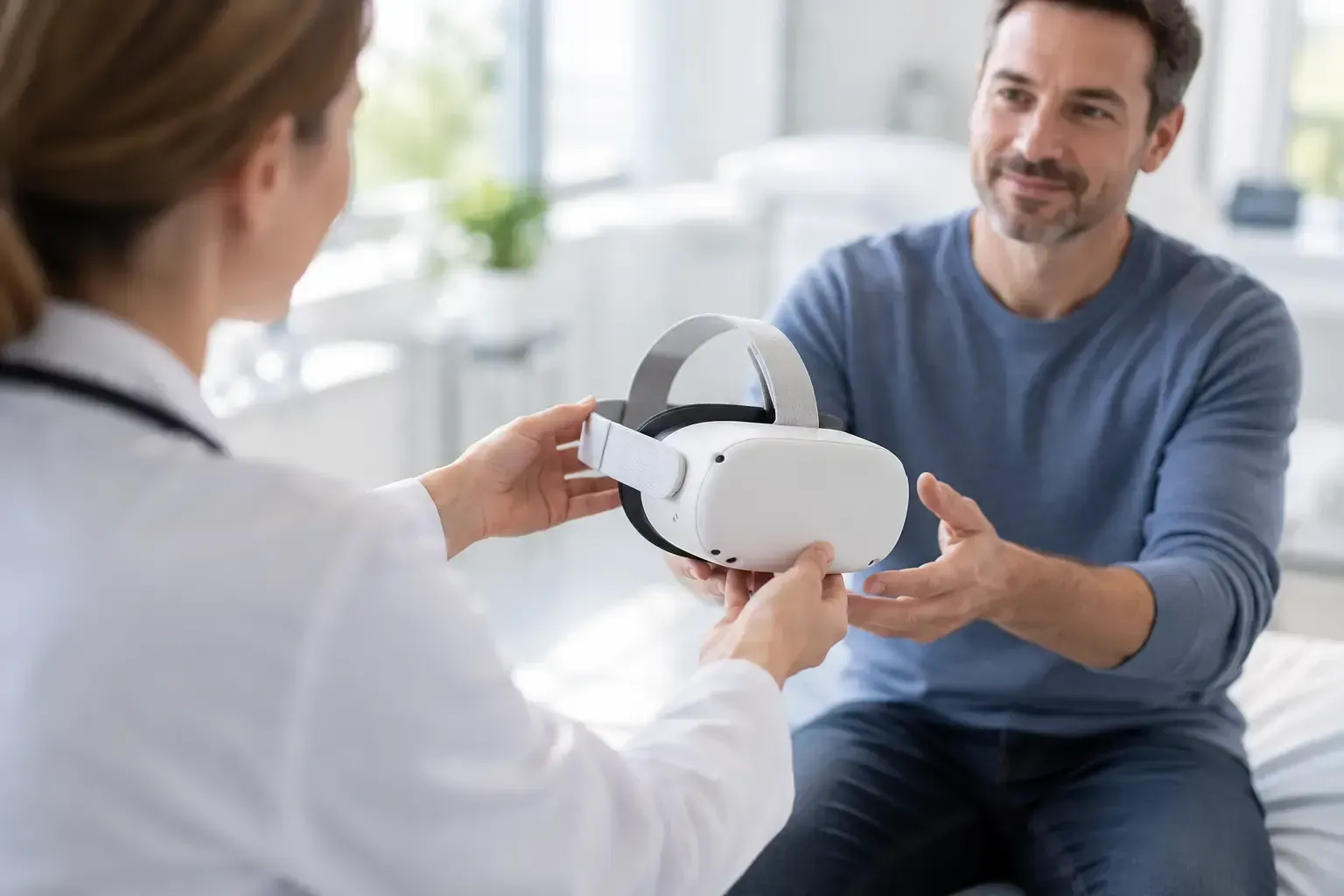
Therapeutic virtual reality differs fundamentally from consumer uses. It relies on precise medical protocols designed with clinical teams and is always used under the supervision of a healthcare professional who adapts the session in real time.
Devices and controlled immersive environments
The patient wears a specialized headset that displays a 360-degree 3D virtual environment. Headphones enhance auditory immersion. Depending on therapeutic needs, controllers or motion sensors complement the setup. This is not a video game. The environments are built according to scientifically validated protocols, and the healthcare professional retains control over the exposure at all times, adjusting the intensity, context or stimuli according to the patient's reactions.
Scientific foundations: cognitive behavioral therapies and habituation
Therapeutic virtual reality draws primarily on the principles of cognitive behavioral therapies (CBT). The central mechanism is habituation: gradually exposing the patient to what causes their pain, anxiety or motor difficulties, in a safe and controlled setting. The brain thus changes its response to stimuli. For pain, immersion diverts attention and reduces brain activity in areas associated with pain perception. For phobias, repeated exposure gradually reduces the anxiety response, without any real risk to the patient.
Virtual reality for pain management: validated clinical results
Pain reduction is one of the most extensively documented applications of VR in healthcare. The results are measurable and reproducible.
In patients with severe burns, perceived pain during care can be reduced by up to 60%[1]. The explanation is neurological: immersion in a virtual environment engages a substantial proportion of the brain's attentional resources. Less attention available for pain signals means reduced pain perception. Measurements of brain activity confirm this reduction in areas associated with pain perception.
This approach extends beyond patients with severe burns. It is used for chronic back pain, neck pain and postoperative pain. Unlike traditional analgesics, VR is a non-pharmacological intervention: no side effects, no risk of dependence. For a patient comparing treatment options, this is a tangible advantage.
Pioneering hospitals in France, including Pitié-Salpêtrière, Cochin, Marseille and Lyon, have incorporated VR into their pain management services. The tool does not replace the care provider. It gives them an additional means of personalizing treatment to each patient's needs.
Post-stroke motor rehabilitation: official recommendations and protocols
VR is establishing itself as a validated complementary tool for improving motor function and balance after a stroke. Official recommendations and clinical evidence converge.
Recommendations from the Haute Autorité de Santé
In France, approximately 140,000 people have a stroke each year. Motor impairments often persist beyond the first few months, well after the acute phase. In this context, the Haute Autorité de Santé has recommended virtual reality since 2022[2] as an adjunct to conventional rehabilitation to improve motor function, with a level of evidence B.
The underlying mechanism is brain plasticity: when the brain is damaged, its structures retain a strong potential for reorganization. This potential is expressed more fully when rehabilitation begins early, in an appropriate and gradual manner. VR creates ideal conditions for stimulating these mechanisms.
Exercises for the upper and lower limbs
Virtual environments make it possible to reproduce everyday movements in an engaging and motivating setting. For the upper limbs: grasping an object, opening a door, pouring a drink. For the lower limbs: crossing a street, climbing stairs, maintaining balance when faced with obstacles.
Where conventional rehabilitation can cause fatigue and loss of motivation through repetitive exercises, VR turns these same movements into purposeful actions directed toward a concrete goal. Patients engage more. This improves the transfer of benefits to everyday activities.
Effectiveness for balance and activity limitation
The 2023 Cochrane review involving 7,188 people[3] who had experienced a stroke provides nuanced evidence. VR leads to a slight improvement in arm function compared with alternative therapies. It is more effective for balance and probably reduces activity limitation. However, no significant benefit was observed for walking speed or quality of life. The evidence also indicates that benefits are more pronounced when patients spend many hours using the program.
Treatment of psychological disorders and phobias
Gradual exposure in a virtual environment is now one of the most structured applications of VR in mental healthcare. The principle is to confront the patient with the anxiety-provoking situation gradually, in a controlled setting, without any real risk.
Dr Éric Malbos, a psychiatrist at the hôpital de la Conception in Marseille, is one of the French pioneers of this approach. His department treats, among other conditions:
- Fear of flying: the patient virtually experiences every stage of a flight, from security screening to turbulence, with the intensity adjusted by the therapist
- Agoraphobia: simulation of open spaces, crowds or public places usually avoided
- Specific phobias: spiders, enclosed spaces, heights, syringes, with each environment designed for gradual exposure
- Post-traumatic stress: reliving traumatic situations in a safe setting, accompanied by a therapist, to gradually desensitize the patient
- Addictive behaviors: AP-HM is conducting studies on smoking cessation using VR, with encouraging results
In real life, these situations are not always easy to reproduce at the right time or approach gradually. This is precisely where VR provides added clinical value.
C2Care offers more than 250 exposure situations covering phobias, social anxiety, public speaking, transport and addictive behaviors. The parameters of each environment—context, stimuli and intensity—can be adjusted according to the patient's reactions and pace, allowing exposure to be adapted to each individual's needs.
C2Care, a leader in immersive technologies for mental health
Create your free account to explore more than 250 virtual reality exposure scenarios and subscribe directly online.
Medical training and education through virtual reality
VR is also transforming how healthcare professionals learn. Surgical simulation, exposure to a wide variety of clinical cases, interaction with 3D anatomical structures: the possibilities are practical and documented.
A medical student can repeat a technical procedure in a virtual environment without any risk to a real patient. This safe repetition improves procedural memory and reduces stress during the first real procedures. Cochrane reviews have assessed VR simulation training in surgery and gastrointestinal endoscopy, concluding that these approaches can complement, or even partially replace, initial training on patients.
Beyond surgery, VR allows students to be exposed to rare clinical situations that they would not necessarily encounter during their standard curriculum. Interaction with 3D anatomical structures provides a spatial understanding that cannot be achieved with a textbook. Medical training using VR is no longer experimental: it is gradually being integrated into university curricula as a complementary teaching tool.
Key takeaways about medical virtual reality
Medical virtual reality is not a gimmick. It is a scientifically validated complementary therapeutic tool, deployed in hospitals in France and governed by official recommendations.
Its three main applications are established: pain management (up to a 60% reduction in patients with severe burns), post-stroke motor rehabilitation (recommended by HAS since 2022, level of evidence B) and treatment of phobias and anxiety disorders through controlled, gradual exposure. Medical training, 3D diagnosis and psychological preparation for procedures complete this overview.
Limitations exist: equipment costs, cybersickness in a small number of patients, and unequal access across regions. These constraints still hinder wider deployment, but 350 facilities in France are already equipped.
One rule remains constant: VR is always used with the support of a healthcare professional. It enhances the therapeutic relationship; it does not replace it.
Medical virtual reality FAQ
Can virtual reality replace traditional medical treatment?
No. VR is a complementary tool for traditional therapies, never a replacement. It is always used with the support of a healthcare professional who adapts the protocol in real time to the patient's needs. Its role is to enhance treatment, individualize it and strengthen the patient's engagement in their care.
What are the adverse effects of therapeutic virtual reality?
A small number of patients report pain, headaches, feelings of weakness or dizziness, similar to motion sickness. The 2023 Cochrane review involving 7,188 people reported no serious adverse effects. These symptoms are generally temporary and disappear after the session. The healthcare professional adjusts the duration and intensity of sessions to limit these effects.
How is virtual reality used in post-stroke rehabilitation?
VR offers game-based motor exercises for the upper limbs (grasping objects, opening doors) and lower limbs (balance, walking, stairs). Recommended by HAS since 2022 with a level of evidence of B, it improves motor function and balance by stimulating brain plasticity. It is always used alongside conventional rehabilitation.
Is virtual reality reimbursed by Sécurité Sociale?
Access to therapeutic VR requires a medical prescription at equipped facilities. Coverage varies depending on protocols and facilities. Some supplementary health insurers may supplement reimbursement from Sécurité Sociale for these innovative treatments. Contact your healthcare facility or treating physician for information.
What types of phobias can be treated with virtual reality?
VR treats a broad range of phobias: fear of flying, agoraphobia, specific phobias (spiders, heights, enclosed spaces), social anxiety and public speaking anxiety. It is also used for post-traumatic stress and addictive behaviors. Current therapeutic solutions offer more than 250 exposure situations with parameters that can be adjusted for each patient.
Which hospitals in France offer access to therapeutic virtual reality?
350 facilities in France use therapeutic VR solutions, including around thirty CHU. Pioneers include Pitié-Salpêtrière (psychiatry and neurology), Sainte-Anne (psychiatry), l'hôpital de la Conception in Marseille (anxiety disorders), as well as the CHU de Lyon, Bordeaux et de la Réunion. Access requires a medical prescription.
Is medical virtual reality suitable for children?
Yes, for certain indications. VR is used in pediatrics to prepare children for anxiety-provoking examinations such as MRI or dental care. Immersion in a calming environment turns a stressful moment into a more tolerable experience. Augmented reality devices are also being studied for the rehabilitation of children with cerebral palsy.
How does a healthcare professional control a virtual reality session?
The professional manages the session from a real-time control platform accessible through a web browser. They can adjust parameters during the session: environmental context, type and intensity of stimuli, and duration of exposure. This control distinguishes professional solutions from consumer applications and ensures continuous adaptation to the patient's reactions.
References
- article
Virtual reality therapy in hospitals: when technology provides care
Alan Assurance Santé
2024View - article
Rehabilitation in the chronic phase of stroke in adults: relevance, indications and methods
Haute Autorité de Santé
2022View - scientific-study
Virtual reality for rehabilitation after stroke (Cochrane review, 7,188 people)
Cochrane
2023View
Author
C2Care
Related articles
Virtual reality in healthcare: therapeutic applications and clinical outcomes in 2026
Virtual reality is transforming medicine: pain management, phobia treatment, post-stroke rehabilitation. Discover clinically validated applications and quantified outcomes in French and international hospitals.
Virtual reality in healthcare: therapeutic applications, measured benefits and real risks
Therapeutic virtual reality has moved from the laboratory to the treatment room. Pain management, phobia treatment, post-stroke rehabilitation: an overview of documented benefits and risks to be aware of.
Virtual reality in hospitals: therapeutic applications and outlook for 2026
Pain management, post-stroke rehabilitation, cybertherapies: virtual reality is establishing itself in French hospitals as a scientifically validated therapeutic tool, with measurable outcomes and growing adoption across healthcare facilities.
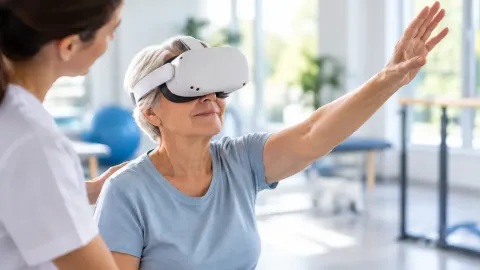
Virtual reality headsets in rehabilitation: applications, effectiveness and protocols in 2026
Virtual reality headsets are becoming established as a validated clinical tool in rehabilitation centres: motor recovery after stroke, neurodegenerative diseases, pain management. Protocols, effectiveness and equipment comparison in 2026.
How virtual reality affects the brain: mechanisms, benefits and precautions
Virtual reality tricks the brain with measurable precision: altered brain waves, areas activated as in a real situation, accelerated learning. Discover the neurological mechanisms, validated benefits and essential precautions.
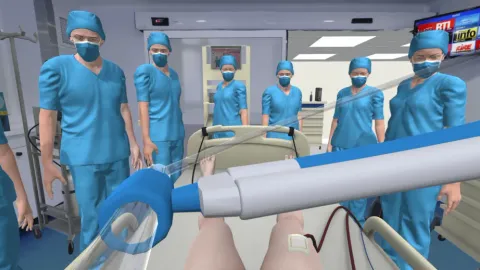
A world first: virtual reality for lung transplantation
For the first time in the world, a patient on the lung transplant list will be able to benefit from therapeutic virtual reality sessions to prevent post-operative psychological trauma, thanks to the unprecedented partnership between C2Care and AP-HM (Public Assistance – Marseille Hospitals).