
Virtual reality in healthcare: therapeutic applications, measured benefits and real risks
Therapeutic virtual reality has moved from the laboratory to the treatment room. Pain management, phobia treatment, post-stroke rehabilitation: an overview of documented benefits and risks to be aware of.
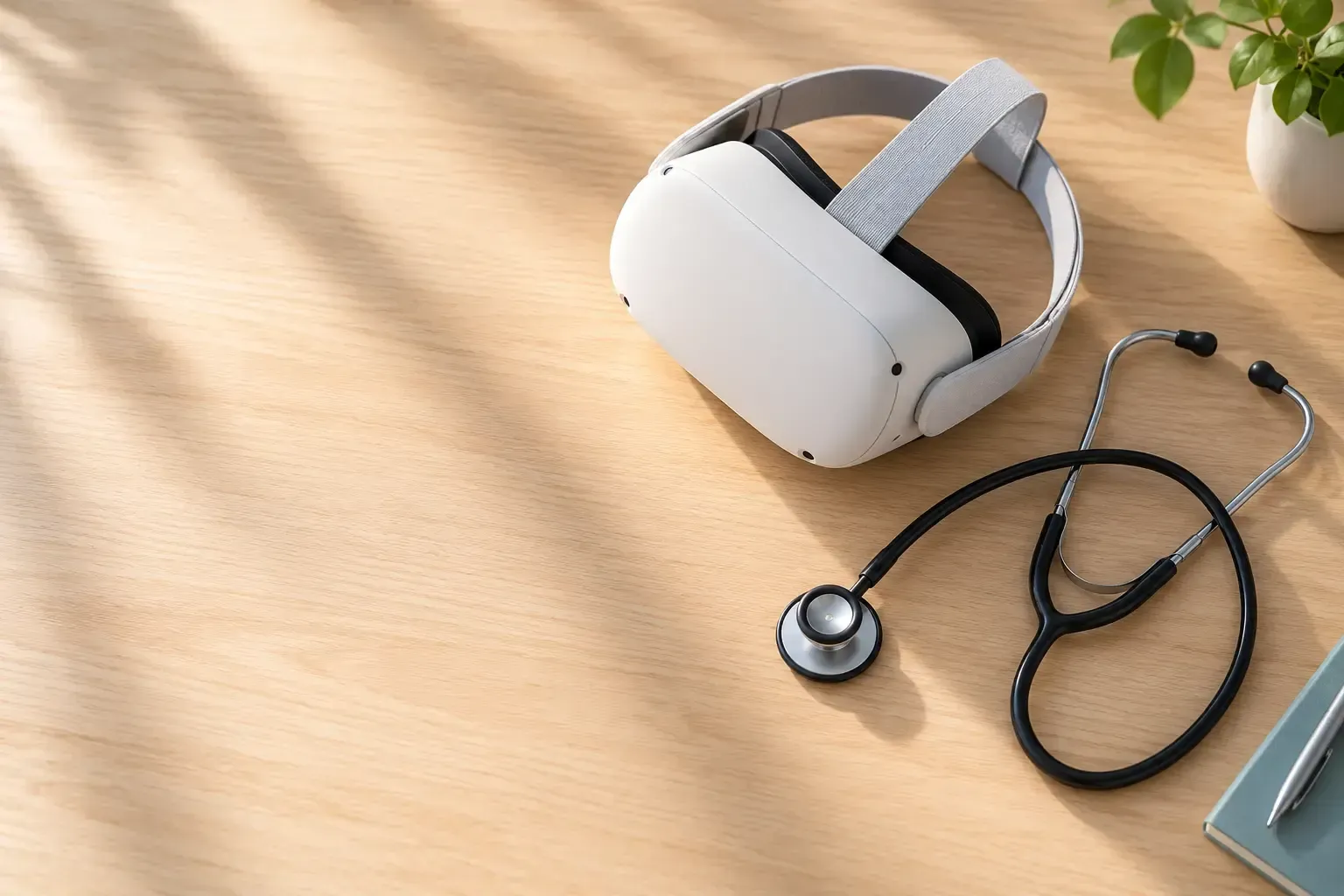
Key facts
- Therapeutic virtual reality has been recommended by the Haute Autorité de Santé for motor rehabilitation after a stroke, with a moderate level of evidence, since 2022.
- It reduces perceived pain by up to 60 % in patients with severe burns during treatment, through attentional distraction.
- Phobias, anxiety disorders, addictions: gradual exposure in a controlled virtual environment produces better outcomes than conventional CBT for certain indications.
- Reversible adverse effects (cybersickness, eye strain, temporary impairment of motor abilities) affect 10 to 30 % of users, depending on the study.
- More than 350 French healthcare facilities are equipped with the professional C2Care solution in 2026, enabling practitioners to control sessions in real time from a unified platform.
How does virtual reality affect the brain and body?
Three mechanisms of action are now scientifically validated: attentional distraction for pain, controlled exposure for anxiety, and multisensory stimulation for motor rehabilitation. These neurophysiological foundations explain why virtual reality produces measurable effects, rather than solely subjective ones.
Attentional distraction and pain reduction
Pain demands attention. This is precisely where virtual reality comes in. According to limited attentional capacity theory, if a significant proportion of cognitive resources is engaged by immersion in a virtual environment, the patient responds more slowly to nociceptive signals. Virtual reality does not interrupt the transmission of pain signals through nerve fibres, but acts on their perception through attention, emotion and concentration.
A study using functional magnetic resonance imaging demonstrated a reduction of more than 50 % in pain-related brain activity in 5 areas of the brain[1] in patients using virtual reality during a painful stimulus. Another study comparing virtual reality with opioid analgesics obtained similar results for pain reduction, with a significant additional reduction when the two approaches were combined.
Gradual exposure and habituation in anxiety disorders
The principle is that of cognitive behavioural therapies, applied in an immersive setting. Patients are gradually exposed to the object of their fear in a safe environment fully controlled by the practitioner. The intensity, context and stimuli can be adjusted in real time according to the reactions observed.
This process of habituation allows the brain to modify its emotional response: through repeated exposure to an anxiety-provoking stimulus without real consequences, it learns to stop triggering a disproportionate fear response. According to published research in psychiatry, virtual reality exposure therapy (VRET) proves more effective than third-wave CBT for certain indications, particularly addictions.
Multisensory stimulation and neuroplasticity in rehabilitation
Visual, auditory and sometimes haptic immersion stimulates several sensory channels simultaneously. This multisensory engagement reinforces motor learning by drawing on mechanisms of neuroplasticity: the brain reorganises its neural connections in response to repeated, structured experiences.
After a stroke, patients practise everyday movements in virtual environments that make training tangible and motivating. Since 2022, this approach has been recommended by the Haute Autorité de Santé[2] as an adjunct to conventional therapy to improve post-stroke motor function, with a moderate level of evidence.
What are the validated therapeutic applications of virtual reality?
Three areas account for most of the evidence: pain management, mental health and functional rehabilitation. In each, controlled studies or official recommendations support clinical use.
Acute and chronic pain management
The most extensively documented results concern patients with severe burns. During particularly painful treatment procedures, immersion in virtual reality reduces perceived pain by up to 60 %. This non-pharmacological approach has a decisive advantage: it limits the side effects and risks of dependence associated with opioids, which have an unfavourable safety profile in children.
In paediatric patients, the evidence is encouraging. A Cochrane review covering 17 studies and 1008 children aged 4 to 18 years[3] assessed the effectiveness of virtual reality distraction during medical procedures: injections, blood draws, dressing changes and physical exercise. Fully immersive virtual reality proved beneficial in reducing pain assessed on the basis of children's behaviour, more effectively than non-virtual distraction. The evidence remains of low to very low certainty, highlighting the need for larger studies.
For chronic pain (back, neck, postoperative), virtual reality is used alongside usual treatments, with the same mechanism of attentional distraction.
Treatment of anxiety disorders and phobias
This is the field in which therapeutic virtual reality has accumulated the most clinical data. Flying phobia, agoraphobia, specific phobias (spiders, heights, enclosed spaces), post-traumatic stress disorder: virtual environments make it possible to recreate situations that are difficult to reproduce in the consulting room, with a degree of precision and gradual progression impossible to achieve otherwise.
Dr Éric Malbos, a psychiatrist at the hôpital de la Conception in Marseille, has treated patients with tobacco dependence using VRET. According to his data, 72 % of patients had not relapsed after treatment, compared with 50 % with conventional CBT. The practitioner controls the intensity of exposure in real time, adjusting the context according to the patient's reactions. VRET is not used alone: it forms part of comprehensive treatment that includes motivational interviewing and, if necessary, medication.
Motor and functional rehabilitation after stroke
Virtual reality transforms rehabilitation exercises into structured, motivating activities. For the upper limbs, it helps patients regain everyday movements: grasping an object, opening a door, pouring a drink. For the lower limbs, it trains balance, walking and coordination by simulating real-life situations such as crossing a street or climbing stairs.
Patient adherence is a key factor. Conventional exercises can seem repetitive; virtual reality introduces clear goals and immediate feedback, improving sustained engagement. In patients with Parkinson's disease, virtual reality improves balance, walking, coordination and certain cognitive functions, and reduces the depressive symptoms frequently associated with this condition. The 2022 HAS recommendation for post-stroke rehabilitation confirms institutional recognition of this approach.
Medical training and clinical simulation: virtual reality as a learning tool
Virtual reality does not benefit patients alone. It is also transforming the training of healthcare professionals by providing a setting for practice that poses no risk to actual patients.
In surgery, virtual reality simulators allow residents to practise complex techniques, precise incisions or endoscopic procedures under reproducible, assessable conditions. Mistakes become learning opportunities rather than dangers. Controlled studies have shown that virtual reality simulation training can supplement, or even partially replace, initial patient-based training in gastrointestinal endoscopy.
Simulating emergency situations is another major application. Managing cardiac arrest, coordinating a team in a recovery room, delivering a difficult diagnosis: these scenarios can be repeated as often as necessary, with configurable variations. Professionals develop automatic responses and stress management skills that then transfer to actual practice.
A less expected use concerns developing empathy. Some programmes immerse healthcare professionals in the perspective of an older patient, a person with a disability or a patient at the end of life. This experience has a lasting effect on how professionals perceive and support their patients.
This application concerns professionals, rather than patients directly. But it helps improve the quality of care: a better-trained surgeon, a more responsive emergency physician and a more attentive healthcare professional make a tangible difference to patient care.
What are the risks and adverse effects of virtual reality in healthcare?
Virtual reality has documented adverse effects. They are generally reversible and short-lived, but certain populations remain at risk and contraindications exist.
Cybersickness: nausea, dizziness and balance problems
Cybersickness is the best-documented adverse effect. It encompasses symptoms similar to motion sickness: nausea, dizziness, sweating, pallor and loss of balance. In susceptible individuals, these symptoms can appear within the first few minutes of use. Its prevalence is estimated at 10 to 30% of users, depending on the study, according to the adverse effects documented by Anses[4].
The good news is that cybersickness disappears when exposure stops. It does not cause lasting after-effects. The recommendation is to stop use immediately as soon as the first symptoms appear.
Eye strain, visual disturbances and blue light
The LED screens in virtual reality headsets emit blue light which, when viewed in the evening or at night, disrupts biological rhythms: delayed sleep onset and disrupted sleep. Eye strain and migraines are also possible after prolonged sessions.
Anses recommends avoiding all screen exposure for two hours before bedtime, particularly for children and adolescents, who are more sensitive to blue light. In therapeutic settings, sessions are supervised and time-limited, which reduces this risk.
Temporary impairment of sensory and motor abilities
After a session, virtual reality can cause temporary changes in sensory, motor and perceptual abilities: impaired manual dexterity and bodily disorientation. These effects are reversible.
Anses recommends a rest period of one to two hours before resuming an activity that requires a high level of concentration, such as driving. Patients must always be informed of this precaution before any session.
At-risk populations and contraindications
Certain profiles require particular vigilance or constitute a formal contraindication. Temporal modulation of the light emitted by LED screens can trigger epileptic seizures in susceptible individuals. Use is also not recommended, or must be medically supervised, for pregnant women, people who experience motion sickness, those with balance disorders or those prone to migraines.
Good to know: Anses recommends stopping use immediately if symptoms appear (nausea, dizziness, sweating) and always informing users about risks and good practices before any session.

C2Care, a leader in immersive technologies for mental health
Create your free account to explore more than 250 virtual reality exposure scenarios and subscribe directly online.
How can people access virtual reality therapy in France?
Access to virtual reality therapy requires a medical prescription. The process begins with a doctor or specialist (psychiatrist, neurologist, rehabilitation physician), who assesses the indication and refers the patient to an equipped facility or practitioner.
Many French facilities have acquired this equipment in recent years. Among the most active are la Pitié-Salpêtrière and l'hôpital Cochin in Paris, l'hôpital de la Conception in Marseille, and CHU in Lyon and Bordeaux. In total, more than 350 French facilities are equipped in 2026, according to C2Care, a French company in the sector that also supports around thirty CHU.
Financial coverage varies by setting. In hospitals, sessions are integrated into the care pathway. In private practice, reimbursement depends on the services billed and the patient's supplementary health insurance. Some mutual health insurers offer packages that partially cover non-drug therapies.
Professional solutions are available for private practitioners wishing to incorporate virtual reality into their practice. C2Care offers a unified platform for controlling exposure in real time, adjusting parameters according to the patient's reactions and accessing more than 250 exposure situations covering phobias, addictions, relaxation and cognitive stimulation. More than 700 practitioners have already been trained in this approach. The flexible subscription at €99/month, with no commitment, makes it easier to incorporate into private practice without a long-term commitment.
Key points about the impact of virtual reality in healthcare
Therapeutic virtual reality is no longer a promise. It is a validated clinical tool, deployed in more than 350 French facilities and recommended by HAS for post-stroke rehabilitation.
Its benefits are measured: pain reduction of up to 60% in patients with severe burns, greater effectiveness than conventional CBT for certain addictions, and improved balance and walking in patients with Parkinson's disease. These results are based on documented neurophysiological mechanisms, not placebo effects.
Adverse effects do exist. Cybersickness, eye strain and temporary impairment of motor abilities affect 10 to 30% of users, but remain reversible. Certain populations (people with epilepsy, pregnant women and people prone to migraines) require particular precautions or constitute a formal contraindication.
Medical support remains essential. Virtual reality does not replace the healthcare professional: it provides an additional tool to personalise treatment, monitor progress and adjust the intensity of sessions. Healthcare professionals now have structured solutions for incorporating this technology into their practice, with full control over the course of each session.
Frequently asked questions about virtual reality in healthcare
What is the definition of virtual reality in healthcare?
Virtual reality in healthcare refers to the use of computer-generated, immersive 3D environments accessed through a headset to treat conditions (pain, phobias, motor disorders) or train professionals. It is based on validated medical protocols and requires support from a healthcare professional. It does not replace the therapist: it provides an additional tool to personalise and control care.
What impact does digital technology have on health?
Digital health is transforming care: telemedicine, connected devices, therapeutic virtual reality. It improves access to care, treatment personalisation and patient adherence. However, it also presents documented risks (eye strain, cybersickness, sleep disruption linked to blue light) that require medical supervision and adherence to good usage practices.
What are the 3 pillars of therapeutic virtual reality?
The three pillars are: immersion (a sense of presence in the virtual environment), interaction (the ability to act within this environment in line with therapeutic goals), and medical control (the practitioner adjusts exposure in real time according to the patient's reactions). Together, these three elements ensure both the clinical effectiveness and the safety of each session.
What is the minimum age for virtual reality in healthcare?
The recommended minimum age varies by manufacturer, often 13 for consumer headsets. In therapeutic settings, virtual reality is used from the age of 4 under strict medical supervision, as shown by the paediatric studies included in the Cochrane review involving 1008 children. Children and adolescents are more sensitive to blue light and adverse effects: heightened vigilance is required.
Is virtual reality reimbursed by Sécurité Sociale?
Coverage depends on the care setting. In hospitals, sessions are integrated into the care pathway. In private practice, reimbursement varies according to the procedures billed and the patient's supplementary health insurance. Some mutual health insurers offer packages for complementary medicine or non-drug therapies that partially cover virtual reality therapy. Check with your insurer before your first session.
What are the side effects of virtual reality?
The most common side effects are cybersickness (nausea, dizziness, sweating, loss of balance), eye strain, migraines and temporary impairment of motor and perceptual abilities. They affect 10 to 30 % of users according to studies, are reversible when exposure stops and disappear after one to two hours of rest. Certain populations (people with epilepsy, pregnant women) are at increased risk.
Can virtual reality treat phobias?
Yes, this is one of its best-documented indications. Virtual reality exposure therapy (VRET) allows patients to be gradually exposed to the object of their fear in a controlled environment. Fear of flying, agoraphobia, spiders, heights, enclosed spaces: outcomes are superior to conventional CBT for certain indications. The practitioner adjusts the intensity of exposure in real time according to the patient's reactions.
Which French healthcare institutions offer virtual reality therapy?
More than 350 French healthcare institutions are equipped with the C2Care solution in 2026, including around thirty CHU. Among the most active are la Pitié-Salpêtrière and hôpital Cochin in Paris, hôpital de la Conception in Marseille (a pioneer in treating phobias with Dr Éric Malbos), as well as CHU in Lyon and Bordeaux. Access requires a medical prescription and support from a trained healthcare professional.
References
- article
Virtual reality for managing pain and anxiety in children
PMC / College of Family Physicians of Canada
2017View - article
Virtual reality therapy in hospitals: when technology provides care
Alan Assurance
View - scientific-study
What are the benefits and risks of using virtual reality to distract children from pain
Cochrane
2019View - article
Virtual reality, augmented reality: what are the risks? What good practices should be adopted?
Anses
2021View
Author
C2Care
Related articles
Virtual reality in healthcare: therapeutic applications and clinical outcomes in 2026
Virtual reality is transforming medicine: pain management, phobia treatment, post-stroke rehabilitation. Discover clinically validated applications and quantified outcomes in French and international hospitals.
Virtual reality in hospitals: therapeutic applications and outlook for 2026
Pain management, post-stroke rehabilitation, cybertherapies: virtual reality is establishing itself in French hospitals as a scientifically validated therapeutic tool, with measurable outcomes and growing adoption across healthcare facilities.
Medical virtual reality: how technology is transforming healthcare
Medical virtual reality is a scientifically validated therapeutic tool already deployed in French CHU. Pain management, post-stroke rehabilitation, phobia treatment: discover its practical applications.
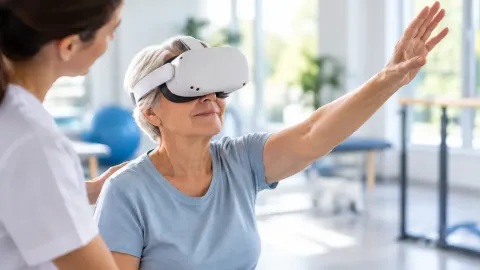
Virtual reality headsets in rehabilitation: applications, effectiveness and protocols in 2026
Virtual reality headsets are becoming established as a validated clinical tool in rehabilitation centres: motor recovery after stroke, neurodegenerative diseases, pain management. Protocols, effectiveness and equipment comparison in 2026.
How virtual reality affects the brain: mechanisms, benefits and precautions
Virtual reality tricks the brain with measurable precision: altered brain waves, areas activated as in a real situation, accelerated learning. Discover the neurological mechanisms, validated benefits and essential precautions.
Virtual reality and social skills training with researchers from Aix-Marseille University.
A doctoral student in psychology in the Social Psychology Laboratory at the University of Aix-Marseille, I work with Dr Del-Monte, Ms Fauvarque, and Professor Graziani on virtual reality in the therapeutic context. In this context, I have had the pleasure of working for 3 years with C2Care software. The plurality and personalization of environments allowed me to have the freedom to direct my research in the desired direction without technological barriers.