
Virtual reality headsets in rehabilitation: applications, effectiveness and protocols in 2026
Virtual reality headsets are becoming established as a validated clinical tool in rehabilitation centres: motor recovery after stroke, neurodegenerative diseases, pain management. Protocols, effectiveness and equipment comparison in 2026.
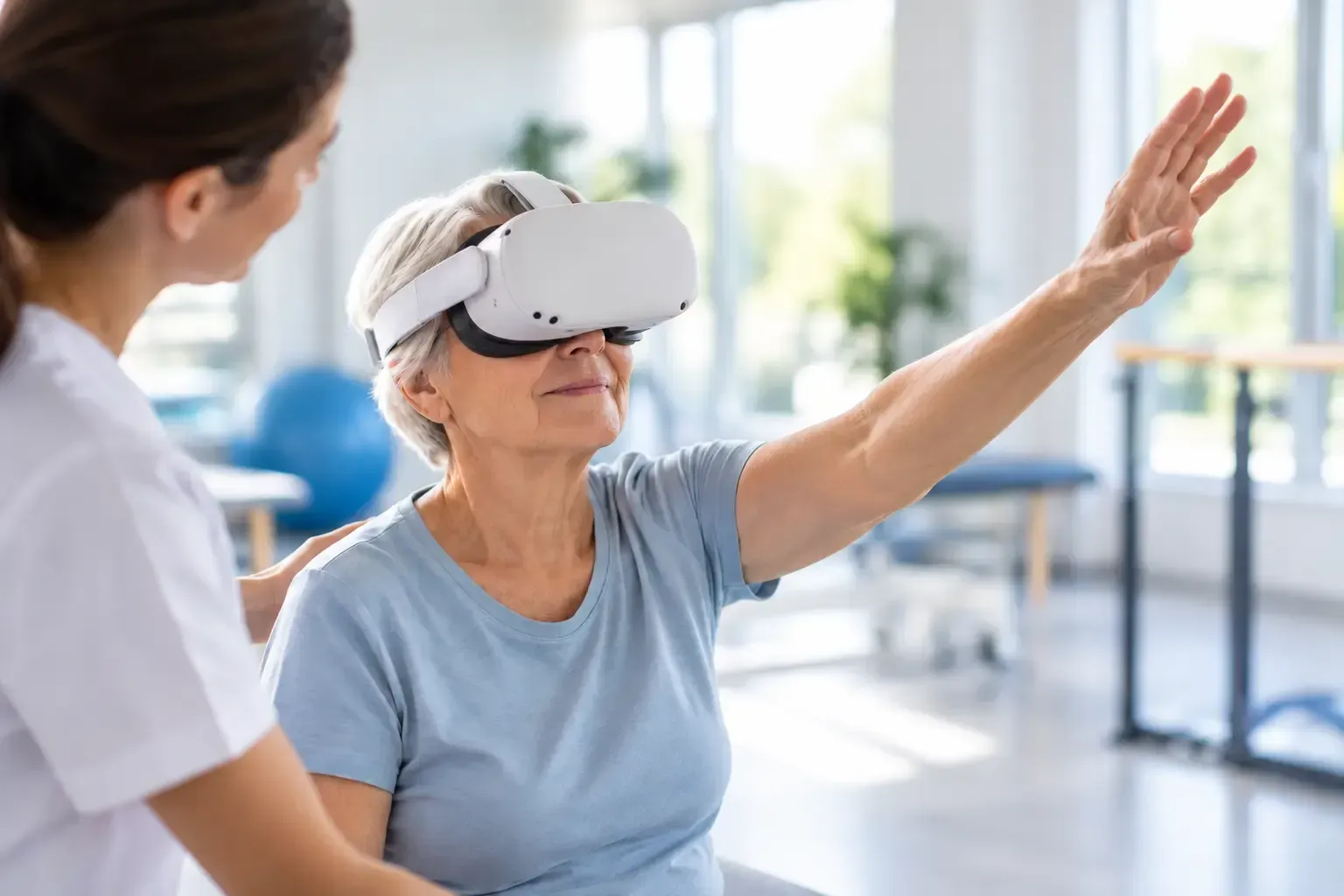
Key facts
- 140,000 strokes per year in France require intensive rehabilitation: VR accelerates motor and cognitive recovery, supported by strong scientific evidence.
- Virtual reality reduces perceived pain by up to 60% in patients with severe burns through attentional distraction.
- A 2025 meta-analysis of 44 studies confirms the effectiveness of VR for balance (SMD = 0.95), particularly in patients with Parkinson's disease.
- Gamification maintains motivation throughout a protocol: up to 5 months for postoperative rehabilitation in children with cerebral palsy.
- Protocols can be adapted to each population: children, older adults, patients with reduced mobility and athletes undergoing reconditioning.
- Solutions such as C2Care allow practitioners to control the session in real time from a browser, without additional specialised equipment.
Why is virtual reality transforming motor and cognitive rehabilitation?
Virtual reality acts on three mechanisms simultaneously: neuroplasticity, multisensory immersion and attentional distraction. This combination is what distinguishes it from conventional methods.
When the brain sustains damage, its structures retain substantial potential for reorganisation. This potential is better realised when rehabilitation starts early, progresses gradually and is appropriately tailored. Immersive extended reality environments meet precisely this requirement: they offer exercises directed towards a concrete goal, much closer to everyday actions than the repetitive, decontextualised movements of traditional protocols.
Every year, 140,000 people experience strokes in France[1], alongside 150,000 traumatic brain injuries and 25,000 new cases of Parkinson's disease. For these patients, the visual, auditory and proprioceptive multisensory stimulation offered by VR strengthens the encoding of motor learning and improves its transfer to real-world activities.
Traditional methods have a well-documented limitation: long, repetitive sessions cause fatigue, pain and loss of motivation. VR overcomes this obstacle by maintaining engagement through interactive, progressively challenging environments.
The controlled immersive environment allows practitioners to retain control over the course of exposure and gradually adapt parameters to the patient's responses. This principle, fundamental in mental health, applies with the same rigour to motor rehabilitation: intensity, duration and task complexity can all be adjusted in real time.
Which conditions benefit most from rehabilitation using VR headsets?
Therapeutic VR now covers a wide range of neurological, orthopaedic and vestibular conditions, with validated protocols for each indication.
Recovery after stroke and traumatic brain injury
This is the area with the largest body of scientific literature. The 2023 Cochrane meta-analysis involving 7,188 patients[2] concludes that virtual reality slightly improves upper limb function compared with alternative therapies, with probable benefits for activity limitations and balance. When VR is added to standard care, without replacing it, functional arm recovery improves measurably.
For the upper limbs, virtual environments allow patients to practise everyday actions: grasping an object, opening a door or pouring themselves a drink. For walking, they simulate real-life situations such as crossing a street or climbing stairs. Functional rehabilitation thus progresses in a motivating setting, with clear goals and immediate feedback.
Neurodegenerative diseases: Parkinson's disease, MS, Alzheimer's disease
Patients with Parkinson's disease particularly benefit from VR protocols focused on balance and coordination. A 2025 meta-analysis of 44 studies reports an effect size of SMD = 0.95 for balance, representing a clinically significant improvement.
For multiple sclerosis, immersive environments improve coordination and certain cognitive functions while reducing depressive symptoms, which are common in these chronic conditions. In patients with Alzheimer's disease, VR-based cognitive stimulation helps maintain functional independence in everyday tasks. In all these cases, gradual adjustment of parameters remains the key to an effective protocol.
Orthopaedic rehabilitation and sports reconditioning
Following anterior cruciate ligament surgery, joint replacement or a severe sprain, VR works on two levels: proprioceptive rehabilitation and treatment of kinesiophobia, the fear of movement that often hinders recovery. Protocols incorporate ROM (range of motion) measurements to objectively assess progress from session to session.
In sports medicine, VR-based reconditioning allows sport-specific situations to be recreated in a controlled environment before returning to the field. Progress is documented and risk-taking is controlled.
Gamification and motivation: how does VR sustain engagement over time?
Rehabilitation is a marathon, not a sprint. Maintaining a patient's motivation over several weeks, or even several months, remains one of the most tangible challenges for care teams.
Postoperative rehabilitation for a child with cerebral palsy lasts an average of 5 months. Research conducted at Université d'Évry shows that VR helps maintain motivation throughout this period through game themes that can be adapted to age and progress. The child wears a headset, sees objects appear to collect and moves to reach them. Gait rehabilitation becomes a game. The programme adapts to the level of disability, age and progress made.
This serious game principle relies on several complementary mechanisms:
- Clear goals: each session offers a defined task with an immediately visible outcome.
- Immediate feedback: patients perceive the effect of their movements on the virtual environment in real time.
- Adaptive difficulty levels: complexity increases gradually according to the patient's abilities, without discouraging jumps.
- Virtual rewards: points, unlocking levels and visible progress all provide positive signals that reinforce engagement.
These mechanisms are not merely incidental. 92% of patients report increased motivation during virtual reality sessions compared with conventional exercises. Adherence to protocols is directly improved as a result, which is a determining factor in long-term clinical effectiveness.
Pain management and kinesiophobia: VR as a non-pharmacological alternative
Pain is a major barrier to rehabilitation. For patients with severe burns, care procedures are among the most painful that exist. Immersion in a virtual environment can reduce perceived pain by up to 60% during these procedures, according to measurements of brain activity that confirm a reduction in areas associated with pain perception.
The mechanism is specific. The immersive environment engages a large share of the brain's attentional resources. By focusing on the virtual world, the patient pays less attention to pain signals. This attentional diversion is not a superficial distraction: it measurably changes brain activity.
This approach also applies to chronic back pain, neck pain and postoperative pain. Its main advantage is that it is non-pharmacological, which limits side effects and the risks of opioid dependence.
Kinesiophobia, the fear of movement, is another common obstacle after surgery or trauma. Patients anticipate pain and restrict their movements, which slows functional recovery. VR allows patients to be gradually exposed to movements in a safe environment, dissociating movement from actual pain.
Since 2022, the Haute Autorité de Santé has recommended virtual reality as an adjunct to conventional therapy to improve motor function after a stroke, with a moderate level of evidence. This official recommendation marks recognition of the approach by French health authorities.
C2Care, a leader in immersive technologies for mental health
Create your free account to explore more than 250 virtual reality exposure scenarios and subscribe directly online.
Protocols and optimal duration: how many sessions are needed for measurable results?
The question comes up consistently in rehabilitation centres: when do results become visible? The answer depends on the condition, session frequency and how sessions are integrated into an overall protocol.
Here are the benchmarks from protocols validated in the literature:
| Condition | Recommended frequency | Protocol duration | Expected results |
|---|---|---|---|
| Stroke (upper limbs) | 2 to 3 sessions/week | 6 to 8 weeks | Improved arm function, reduced activity limitations |
| Parkinson's disease (balance) | 2 sessions/week | 8 weeks | SMD = 0.95 for balance, improved coordination |
| Orthopaedic rehabilitation | 2 to 3 sessions/week | 4 to 6 weeks | Increased ROM, reduced kinesiophobia |
| Cerebral palsy (children) | Regular sessions | 5 months | Sustained motivation, improved walking |
| Chronic pain management | 1 to 2 sessions/week | 4 to 8 weeks | Reduced perceived pain, reduced use of analgesics |
Adherence is the determining factor. An 8-week protocol that the patient follows fully produces better results than a 12-week protocol with frequent dropouts. VR specifically improves this adherence rate through the engagement it generates.
Each session generally lasts between 20 and 45 minutes, depending on the condition and the patient's tolerance. Short, frequent sessions are often preferable to longer, more widely spaced sessions, particularly during the acute phase of recovery.
VR headsets in rehabilitation: technical comparison and equipment selection
The choice of headset determines the quality of immersion, the accuracy of movement tracking and durability in a clinical setting. Two main categories coexist.
Consumer headsets adapted for clinical use
Meta Quest (2, 3, 3S, Pro) and Pico (Neo 3 Pro, 4, Ultra) headsets are the most widely used in rehabilitation centres. Their value for money, standalone operation and library of therapeutic content make them suitable choices for practitioners in private practice and small facilities. They do not require a dedicated PC and operate in standalone mode.
Their main limitation is that they were not designed for intensive use in hospitals. Hygiene between patients, strap durability and software update management require rigorous organisation.
Proprietary hospital systems
Some facilities opt for integrated solutions designed specifically for clinical settings: precise motion sensors, interfaces adapted to patients with reduced mobility and data traceability for each patient. These systems offer better integration into hospital workflows, but at a higher cost.
The decisive criterion remains the type of protocol being considered: phobias, addictions, relaxation and cognitive stimulation do not require the same level of immersion or the same sensors.
Some solutions, such as the one offered by C2Care for healthcare facilities, allow sessions to be managed through a standard web browser on a PC, Mac or tablet, without additional specialised equipment. The practitioner retains real-time control over exposure, regardless of the headset used. This way of operating simplifies deployment in departments where several professionals work with the same patients.
FAQ about virtual reality headsets in rehabilitation
Is virtual reality reimbursed by the Sécurité Sociale for rehabilitation?
VR in rehabilitation requires a medical prescription. Coverage by the Sécurité Sociale depends on the facility and the protocol: some procedures are partially reimbursed as part of a hospital stay or specialist consultation. Some supplementary health insurers provide additional coverage. Fees vary according to the duration and type of protocol. Ask your healthcare facility for information.
How many VR sessions are needed to see improvement after a stroke?
According to validated protocols, 2 to 3 sessions per week for 6 to 8 weeks allow measurable improvements in upper limb function and balance to be observed. Progress depends on the stage of recovery, session intensity and personalised follow-up by the therapist. Adherence to the protocol remains the most decisive factor.
What are the possible side effects of using a VR headset in rehabilitation?
The most common side effects are dizziness, nausea and eye strain. They are generally temporary and decrease with short, gradually extended sessions. VR is contraindicated in patients with photosensitive epilepsy. Professional support is mandatory to adapt exposure to each patient's individual reactions.
Can VR completely replace conventional rehabilitation?
No. VR is an adjunct to conventional protocols, not a replacement. It enhances rehabilitation, improves motivation and facilitates the transfer of acquired skills to everyday activities. It always requires supervision by a therapist and is integrated into comprehensive care combining conventional physical exercises and clinical follow-up.
Which conditions are best addressed by virtual reality rehabilitation?
The scientific evidence is strongest for recovery after stroke (upper limbs, balance), Parkinson's disease and postoperative orthopaedic rehabilitation. VR is also used for multiple sclerosis, Alzheimer's disease, chronic pain management and return-to-sport conditioning. Each indication has specific protocols adapted to the condition.
Is virtual reality rehabilitation suitable for children?
Yes, provided the content is adapted to their age and level of disability. Adaptable programmes, such as those used for postoperative rehabilitation in children with cerebral palsy, offer game themes that evolve with progress. The playful aspect sustains motivation throughout protocols lasting several months. Professional support remains essential.
Which VR headset should you choose for a physiotherapy practice?
Meta Quest and Pico headsets are the most widely used in private practice because of their standalone operation and compatibility with therapeutic software. The choice depends on the type of protocol intended, the duration of the commitment and the budget. Some solutions allow sessions to be controlled through a standard browser, without additional equipment, making them easier to integrate into daily practice.
Is VR in rehabilitation effective for managing chronic pain?
The available evidence shows a significant reduction in perceived pain through attentional distraction. In patients with severe burns, this reduction reaches up to 60% during care. For chronic back pain or postoperative pain, VR offers a non-pharmacological alternative that limits the risks of habituation to analgesics. Medical follow-up remains essential.
References
- article
How immersive “extended reality” technologies are reshaping motor rehabilitation
Université Rennes 2 / The Conversation
2025View - scientific-study
Virtual reality for rehabilitation after a stroke (Cochrane meta-analysis 2023, 7 188 patients)
Cochrane
2023View
Author
C2Care
Related articles
Virtual reality in healthcare: therapeutic applications and clinical outcomes in 2026
Virtual reality is transforming medicine: pain management, phobia treatment, post-stroke rehabilitation. Discover clinically validated applications and quantified outcomes in French and international hospitals.
Virtual reality in hospitals: therapeutic applications and outlook for 2026
Pain management, post-stroke rehabilitation, cybertherapies: virtual reality is establishing itself in French hospitals as a scientifically validated therapeutic tool, with measurable outcomes and growing adoption across healthcare facilities.
Virtual reality in healthcare: therapeutic applications, measured benefits and real risks
Therapeutic virtual reality has moved from the laboratory to the treatment room. Pain management, phobia treatment, post-stroke rehabilitation: an overview of documented benefits and risks to be aware of.
Medical virtual reality: how technology is transforming healthcare
Medical virtual reality is a scientifically validated therapeutic tool already deployed in French CHU. Pain management, post-stroke rehabilitation, phobia treatment: discover its practical applications.
How virtual reality affects the brain: mechanisms, benefits and precautions
Virtual reality tricks the brain with measurable precision: altered brain waves, areas activated as in a real situation, accelerated learning. Discover the neurological mechanisms, validated benefits and essential precautions.
Virtual reality therapy to break the isolation of seniors – Clinical study of CHU in Nice
C2Care collaborated with CHU in Nice, as part of the “Bien Aging” project, on a clinical study integrating virtual reality with EHPAD residents. By relying on reminiscence therapy and personalized immersive content, the objective is to stimulate the autobiographical memory of seniors, improve their mood and break the isolation, particularly accentuated in people with mild to moderate cognitive disorders.